Showing posts with label jack nicholson. Show all posts

Friday, August 19, 2011

Head (1968)

Directed by Bob Rafelson
Written by Bob Rafelson and Jack Nicholson

I got "Head" (no jokes, please) as a part of a multi-film set. I was intrigued by what I knew about it, that Jack Nicholson had cowritten and that it was more or less a movie about the music group The Monkees. Not being a big Monkees fan myself, I wasn't sure what to expect. What I got was a layered psychedelic experience unlike any other that transcended genre and managed to be both light and extremely head-y. (Sorry, I have a weakness for puns. I know it's no way to get a-head in life *snicker*)

The film contains elements of the following genres at various points: concert film, Beatles'-style "day-in-the-life-of-the-band" video, mockumentary, western, sketch comedy, horror, political satire, adventure, epic, madcap comedy, romantic drama, and a very large dose of psychedelica. But in addition to that, it has subtly clever dialogue ("Nobody ever lends money to a man with a sense of humor"), and is written to reward repeat viewings. It even has a segment that I'm fairly certain is a reference to 8 1/2, one of my favorite films of all time and another great example of a film that completely obscures the boundaries between reality and fantasy.
This film is all about distorted reality. The first distortion is the most obvious: drugs. Most of the music sequences are just pretty escapist fantasy scenes featuring combinations of sound and color for people to zone out on psychedelics to. Though members of the band refer to the film as a kids film, the posters at the time of the release emphasized "Not Suitable For Children". At one point, Micky is in a harem, surrounded by dancing girls, smiling widely and smoking from a hookah. In another, the whole band has shrunk down and been sucked into a vacuum where they find a (relatively) giant joint roach, which Micky calls a "zoomer". But the druggiest parts of the film aren't druggy because there are drugs in them, but because they're edited like an acid trip, with lots of color distortion, slow-motion and mirroring effects. I wouldn't advise this film for actual hallucinators though. The latter third gets a little dark and might induce "a bad time".
The second distortion of reality in the film is the media itself. Early on in the film, a bank of televisions shows different scenes from different genres as the Monkees sing cryptically "We hope you like our story / Although there isn't one / That is to say, there's many / That way, there is more fun!" The televisions appear to show random assorted material, but on rewatching, every scene shown actually occurs later in the film. Throughout the film, the characters repeatedly find themselves suddenly in a vastly different circumstance and genre than before. They even jump around chronologically throughout scenes of the movie. In one of my favorite scenes (the one that is a reference to 8 1/2), Peter (who is referred to elsewhere as "the dummy" of the group) finds himself in a sauna with a Hindu yogi (in 8 1/2, the main character has a very dream-like discussion with a Catholic Cardinal in a steam bath). The yogi proceeds to explain that the human mind has no way of differentiating between sounds and images and the actual experiences they represent. Therefore images from TV, music that we listen to, things that are part of our cultural consciousness, whether it's cartoons, an opera or footage from Vietnam, all gets interpreted by the subconscious as hard fact, experienced first-hand. The film is like a documentary of the process of the subconscious cycling through the assorted and disparate information it's given. The resulting confusion accounts for part of the film's disjointed plot.
The film industry itself is depicted in the film as a giant, dangerous factory full of uncaring middle managers who continually usher the Monkees into a large, black steel box. The film makes it seem like the Monkees are indentured servants to their director, label and even fans. They express frustration with a lack of creative control. Repeatedly throughout the film the Monkees try to rebel against the process of making the film itself, walking off the set and busting through the fourth wall in a jaded attempt to find reality again. In the mockumentary filmmaking portions the Monkees are treated like a disease by the other cast and crew in craft services ("I can't eat with those damned kids around" "Those guys are just awful" "Well if it isn't God's gift to 8-year olds"). In one scene, after a successful live performance, the Monkees are literally torn to shreds by their adoring fans.
Apparently most of this stuff was based on the real life making of "Head". According to the Wikipedia page for the film, the band brainstormed the plot of the movie with writer Jack Nicholson and writer/director Bob Rafelson one weekend while consuming copious amounts of marijuana. When they learned they weren't receiving any writing credits for the film, all of the Monkees (save the drummer, Pete) walked off the set and refused to act again until the terms of their contract were renegotiated. The cast and crew of the film really did hate the Monkees, and regularly left Craft Services en masse to avoid eating with them. And due to the Monkees' habit of wandering off of the set between shots, a large, black box was constructed with a heavy steel door to act as their personal waiting room in between takes.
If the process of filming weren't hard enough on the group, the film's critical reception at the time of its release was ice-cold. The Monkees effectively alienated the fan base they'd built on their clean-cut family-friendly images from their popular TV show while completely failing to draw in a new hip, adult audience. Only in retrospect did this film find the turned-on, groovy audience it was looking for, finally attaining its well-deserved cult status with college students and the art house crowd many years after its initial release.
So what does "Head" have to offer modern day groovy guys and gals? Monty-Pythonesque humor and transitions, a strong anti-war message (still pertinent today), groovy psychedelics, a film about filmmaking (which I personally love), random cameos ranging from Jack Nicholson (blink and you'll miss it) and Annette Funicello to Frank Zappa (pictured above), and more zany antics than the average Beatles' film.
As for my favorite Monkee (based on the film), I would have to pick Pete. He's the warm-hearted simpleton who lets an ice-cream cone melt down his hand rather than throwing it away because "There are starving Chinese". He's called "the dummy" of the group, but watch him closely. He will ultimately become the most enlightened one. The most fun Monkee to watch would be Micky, who energetically manhandles a Coke machine when he comes upon it in the desert only to find it empty. He later blows it up with a tank.
I gave "Head" (no jokes, please) a 9/10. If you are a fan of mystery, horror, suspense, documentaries, dramas, love stories, concert films, westerns, sketch comedy, action, or any of the other genres this film encapsulates, chances are this film will have something for you. So light up some.... incense, and get ready for a groovy trip back in time...


For those of you interested in "Head" (no jokes, please) and other American cinema from the late 60's and early 70's, I highly recommend the American Lost and Found: The BBS Story box set, available on DVD and Bluray. The set includes "Head", "Easy Rider", "Five Easy Pieces", "Drive, He Said", "A Safe Place",  "The Last Picture Show", and "The King of Marvin Gardens". This and other recommended viewing below:


Tuesday, April 6, 2010

The Terror (1963)

Directed by Roger Corman
Written by Leo Gordon and Jack Hill

Rated PG for frightening imagery and situations.

"The Terror" is one of many old films that are now public domain. This means that anyone with a copy of this film can reproduce and even sell it with no copyright penalties. So go burn a copy today! "The Terror" has also been made available to watch or download for free here.

In addition to being free, "The Terror" also boasts the unlikely pairing of Boris Karloff and Jack Nicholson in the lead roles. For fans of Karloff's later work and Nicholson's earlier work, "The Terror" should be a special treat!

The film opens with a really neat animation sequence featuring ghostly images flying around cartoonish Gothic architecture to intense instrumental music as the opening credits play. This animation reminded me of the credit sequences of old Warner Brothers' cartoons. At it's heart, "The Terror" is a Gothic fairy tale, and I feel the opening animation does an excellent job of setting the mood.
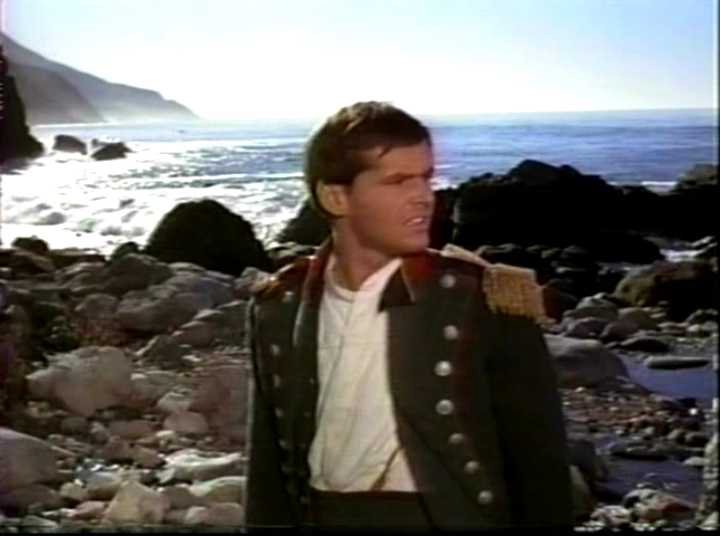
Jack Nicholson stars as Andre Duvalier, a lieutenant in Napoleon's army who has been separated from his regiment and wanders along an anonymous beach, close to exhaustion. Just as he's near losing consciousness from heat-stroke, he meets Helene (Sandra Knight), a beautiful young woman who helps him find fresh water and flirts with him mercilessly. Suddenly, Helene starts walking straight into the ocean. Andre tries to rescue her, but nearly drowns himself, and is attacked by a malicious falcon as he struggles against the strong current. Apparently Jack Nicholson's performance here wasn't all acting. The actor later revealed that he almost drown himself when this scene was being filmed.
Duvalier awakens in the cottage of Katrina (Dorothy Neumann), an old woman so ugly she can only be a witch. Katrina claims to have rescued Andre from the ocean, and that she knows nothing about a girl in the area. When Andre is well enough, he sets out to explore the area. He quickly encounters Helene (Sandra Knight) and follows her into the forest. As he chases after Helene, Duvalier is grabbed by a young local named Gustaf. Gustaf explains that the ground Duvalier was headed towards is deadly quicksand. Andre remarks "She tried to kill me". Gustaf cryptically responds "It's not her fault. Her will is not her own". Gustaf reveals that the girl lives at the castle of the reclusive and long-named Baron Victor Frederick von Leppe (Boris Karloff).
Baron von Leppe, like every truly nefarious Gothic noble, lives in a beautiful Gothic castle perched on a cliff. Upon his arrival, Andre sees Helene looking out of one of the castle's windows. Andre knocks on the large front door and is greeted by Baron von Leppe himself, who assures him that there is no woman in the castle. Andre demands (quite rudely, I might add) to stay the night at the castle instead of one of the village inns. The Baron grudgingly obliges. Once inside the lush castle, von Leppe shows Duvalier an old painting of a beautiful woman who bears a striking resemblance to Helene. The Baron suggests that perhaps Andre saw the painting through the window and mistook it for a living girl. The woman in the painting is the Baron's late wife, the Baroness Ilsa von Leppe. Uncertain how to proceed, Duvalier settles in for the night, making himself at home in the Baron's creepy castle.
Andre awakes during the night to find Helene walking through the moonlit graveyard under the window to his room. He follows her. She leads him to the entrance to the tomb of the Baroness von Leppe in the crypt under the castle and then disappears. [An interesting historical goof: Nicholson carries a snub-nosed revolver with him as he creeps around the castle. Revolvers weren't invented until several decades after the film is set, and the snub-nosed version wasn't really seen in Europe at all, but in the American West.] Again confounded by the hot but elusive Helene, Andre has every intention of taking his horse and leaving the area, but is told that his horse has escaped during the night and is missing. Enraged, he takes his anger out on the Baron's butler, Stefan. Stefan assures Duvalier that he will get him a new horse as soon as possible ("Believe me, Lieutenant, I have no desire to interfere with your departure from this castle."), but for the time being, Andre is stuck in the decrepit mansion.
One of the highlights of this film is watching Jack Nicholson be incredibly rude to people. Long before Jack Nicholson was the great actor we now know him to be, he had a great talent for being arrogant and abrasive on film. In "The Terror", Nicholson is almost a one-note pony. He goes from horny to insensibly angry and back to horny again with little provocation.
Unable to find Helene or any explanation for the mystery surrounding her and the castle, Duvalier confronts Baron von Leppe, demanding answers. After a bit of resistance, von Leppe tells the story of his meeting with his wife, Ilsa. She was a peasant girl. By all rights, in those times, a Baron could have "claimed" her as his own without any problems, but he chose to court her and woo her instead. He went off to fight in a war, and when he returned, he found a man named Erik with Ilsa in her bed. Baron Victor tells Duvalier how he murdered Ilsa in a rage, and how Stefan "took care of" Erik. Haunted by his past and miserable, the Baron reveals that he's seen Ilsa several times since he killed her, and that he looks forward to her occasional hauntings because he gets to see her again.
Things become further confused when Duvalier discovers that Katrina the witch is using Helene to channel the spirit of the dead Baroness in order to push the Baron to suicide. Why would she go to such lengths to punish the Baron? What is Katrina's connection to Erik, the dead Baroness' lover? In a thrilling twist-ending, Roger Corman turns our expectations on their heads to unveil the shocking truth about the von Leppes.

"The Terror" is not driven by excellent writing, acting or plot. It is more of an atmospheric horror piece, akin to "Night of the Living Dead" or "Carnival of Souls". That is not to say that acting, writing and plot aren't there, they just take a back seat to the slow-burn terror of "The Terror". Karloff (who at this point in his career was declining in popularity) gives a good performance as Baron von Leppe, and Nicholson is adequate as Andre Duvalier, but neither of them are at their peak.

The locations used in the film are almost surreal. All of the sets were left-overs from "The Raven", another Corman production. "The Terror" is rumored to have been shot mostly in the four days following the completion of filming on "The Raven". Corman used the sets as much as possible before they were torn down. The rest of the film was pieced together patch-work by several other filmmakers who collaborated to complete Corman's vision. These included a young Francis Ford Coppola and Jack Nicholson himself. What results is a varied tapestry of plot threads that actually go together quite nicely.

I give "The Terror" an 8/10. It's haunting, beautifully-shot, and genuinely entertaining. I got a 1$ copy of this DVD at the Dollar Tree and it was well worth it. The low-quality video and audio added to the film's nostalgic fairy-tale creepiness. The story is engaging and intelligent (though the plot falls apart a little under scrutiny), and the visuals are breath-taking. So if you're a fan of Gothic horror, fairy tales or ghost stories, stop what you're doing right now and watch "The Terror" for free online:


Like it enough to buy it?


Also check out these other great films: