Showing posts with label public domain. Show all posts

Tuesday, April 6, 2010

The Terror (1963)

Directed by Roger Corman
Written by Leo Gordon and Jack Hill

Rated PG for frightening imagery and situations.

"The Terror" is one of many old films that are now public domain. This means that anyone with a copy of this film can reproduce and even sell it with no copyright penalties. So go burn a copy today! "The Terror" has also been made available to watch or download for free here.

In addition to being free, "The Terror" also boasts the unlikely pairing of Boris Karloff and Jack Nicholson in the lead roles. For fans of Karloff's later work and Nicholson's earlier work, "The Terror" should be a special treat!

The film opens with a really neat animation sequence featuring ghostly images flying around cartoonish Gothic architecture to intense instrumental music as the opening credits play. This animation reminded me of the credit sequences of old Warner Brothers' cartoons. At it's heart, "The Terror" is a Gothic fairy tale, and I feel the opening animation does an excellent job of setting the mood.
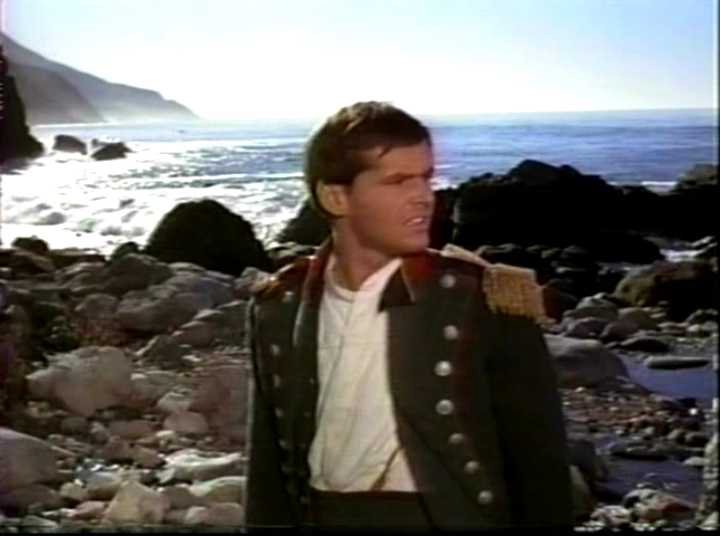
Jack Nicholson stars as Andre Duvalier, a lieutenant in Napoleon's army who has been separated from his regiment and wanders along an anonymous beach, close to exhaustion. Just as he's near losing consciousness from heat-stroke, he meets Helene (Sandra Knight), a beautiful young woman who helps him find fresh water and flirts with him mercilessly. Suddenly, Helene starts walking straight into the ocean. Andre tries to rescue her, but nearly drowns himself, and is attacked by a malicious falcon as he struggles against the strong current. Apparently Jack Nicholson's performance here wasn't all acting. The actor later revealed that he almost drown himself when this scene was being filmed.
Duvalier awakens in the cottage of Katrina (Dorothy Neumann), an old woman so ugly she can only be a witch. Katrina claims to have rescued Andre from the ocean, and that she knows nothing about a girl in the area. When Andre is well enough, he sets out to explore the area. He quickly encounters Helene (Sandra Knight) and follows her into the forest. As he chases after Helene, Duvalier is grabbed by a young local named Gustaf. Gustaf explains that the ground Duvalier was headed towards is deadly quicksand. Andre remarks "She tried to kill me". Gustaf cryptically responds "It's not her fault. Her will is not her own". Gustaf reveals that the girl lives at the castle of the reclusive and long-named Baron Victor Frederick von Leppe (Boris Karloff).
Baron von Leppe, like every truly nefarious Gothic noble, lives in a beautiful Gothic castle perched on a cliff. Upon his arrival, Andre sees Helene looking out of one of the castle's windows. Andre knocks on the large front door and is greeted by Baron von Leppe himself, who assures him that there is no woman in the castle. Andre demands (quite rudely, I might add) to stay the night at the castle instead of one of the village inns. The Baron grudgingly obliges. Once inside the lush castle, von Leppe shows Duvalier an old painting of a beautiful woman who bears a striking resemblance to Helene. The Baron suggests that perhaps Andre saw the painting through the window and mistook it for a living girl. The woman in the painting is the Baron's late wife, the Baroness Ilsa von Leppe. Uncertain how to proceed, Duvalier settles in for the night, making himself at home in the Baron's creepy castle.
Andre awakes during the night to find Helene walking through the moonlit graveyard under the window to his room. He follows her. She leads him to the entrance to the tomb of the Baroness von Leppe in the crypt under the castle and then disappears. [An interesting historical goof: Nicholson carries a snub-nosed revolver with him as he creeps around the castle. Revolvers weren't invented until several decades after the film is set, and the snub-nosed version wasn't really seen in Europe at all, but in the American West.] Again confounded by the hot but elusive Helene, Andre has every intention of taking his horse and leaving the area, but is told that his horse has escaped during the night and is missing. Enraged, he takes his anger out on the Baron's butler, Stefan. Stefan assures Duvalier that he will get him a new horse as soon as possible ("Believe me, Lieutenant, I have no desire to interfere with your departure from this castle."), but for the time being, Andre is stuck in the decrepit mansion.
One of the highlights of this film is watching Jack Nicholson be incredibly rude to people. Long before Jack Nicholson was the great actor we now know him to be, he had a great talent for being arrogant and abrasive on film. In "The Terror", Nicholson is almost a one-note pony. He goes from horny to insensibly angry and back to horny again with little provocation.
Unable to find Helene or any explanation for the mystery surrounding her and the castle, Duvalier confronts Baron von Leppe, demanding answers. After a bit of resistance, von Leppe tells the story of his meeting with his wife, Ilsa. She was a peasant girl. By all rights, in those times, a Baron could have "claimed" her as his own without any problems, but he chose to court her and woo her instead. He went off to fight in a war, and when he returned, he found a man named Erik with Ilsa in her bed. Baron Victor tells Duvalier how he murdered Ilsa in a rage, and how Stefan "took care of" Erik. Haunted by his past and miserable, the Baron reveals that he's seen Ilsa several times since he killed her, and that he looks forward to her occasional hauntings because he gets to see her again.
Things become further confused when Duvalier discovers that Katrina the witch is using Helene to channel the spirit of the dead Baroness in order to push the Baron to suicide. Why would she go to such lengths to punish the Baron? What is Katrina's connection to Erik, the dead Baroness' lover? In a thrilling twist-ending, Roger Corman turns our expectations on their heads to unveil the shocking truth about the von Leppes.

"The Terror" is not driven by excellent writing, acting or plot. It is more of an atmospheric horror piece, akin to "Night of the Living Dead" or "Carnival of Souls". That is not to say that acting, writing and plot aren't there, they just take a back seat to the slow-burn terror of "The Terror". Karloff (who at this point in his career was declining in popularity) gives a good performance as Baron von Leppe, and Nicholson is adequate as Andre Duvalier, but neither of them are at their peak.

The locations used in the film are almost surreal. All of the sets were left-overs from "The Raven", another Corman production. "The Terror" is rumored to have been shot mostly in the four days following the completion of filming on "The Raven". Corman used the sets as much as possible before they were torn down. The rest of the film was pieced together patch-work by several other filmmakers who collaborated to complete Corman's vision. These included a young Francis Ford Coppola and Jack Nicholson himself. What results is a varied tapestry of plot threads that actually go together quite nicely.

I give "The Terror" an 8/10. It's haunting, beautifully-shot, and genuinely entertaining. I got a 1$ copy of this DVD at the Dollar Tree and it was well worth it. The low-quality video and audio added to the film's nostalgic fairy-tale creepiness. The story is engaging and intelligent (though the plot falls apart a little under scrutiny), and the visuals are breath-taking. So if you're a fan of Gothic horror, fairy tales or ghost stories, stop what you're doing right now and watch "The Terror" for free online:


Like it enough to buy it?


Also check out these other great films:

Sunday, March 28, 2010

Stream Classic Films for Free at Mike's Movie Review Blog!

As those of you who read my reviews regularly probably already know, I have been imbedding full-length, streaming versions of the films I review in my blog posts whenever possible. In order to make it easier for you to find the film you want to watch, here is the current list of blog posts that include streaming videos of the films being reviewed with brief plot synopses:

"Asylum" - A horror omnibus starring Peter Cushing and Brit Ekland about an insane asylum whose inhabitants are not what they seem.

"The Brain that Wouldn't Die" - A super low-budget sci-fi flick about a mad scientist who will stop at nothing to keep his fiancee's severed head alive.

"Cat Girl" - Barbara Shelley stars as a newlywed who inherits a family curse from her dying uncle that brings out the cat in her.

"Corridors of Blood" - Boris "Frankenstein" Karloff stars as an addiction-prone surgeon who is desperate to discover a way to perform painless surgery.

"Curse of the Voodoo" - B-horror star Bryant Haliday stars as a British safari guide who is cursed by lion-worshipping African tribesmen.

"Devil Doll" - Bryant Haliday stars as "Vorelli the Great", an evil hypnotist/ventriloquist whose dummy assistant has a life of his own.

"Fiend Without a Face" - Atomic powers render a mad scientist's sheer thought into dangerous, alien brain-creatures.

"Night of the Living Dead" - The original George A. Romero zombie masterpiece, in all of its glory.

"Nosferatu" - An early, unauthorized adaptation of Dracula by German Expressionist F.W. Murnau (Blog entry is for the film "Shadow of the Vampire" (2000), but the video player for "Nosferatu" is at the bottom of the review page).

"The Terror" - A Gothic fairy tale starring Boris Karloff ("Frankenstein") and Jack Nicholson ("The Shining").

"White Zombie" - A very early zombie film starring Bela "Dracula" Lugosi as a zombie-making voodoo practitioner in Haiti.

The imbedded videos are towards the bottom of the review post pages, but feel free to skip the review, watch the film, and formulate an opinion on your own! The imbedded video players feature full-screen options so you can kick back, relax, and watch great movies on your computer. Some of the films have short commercials at the beginning and near the half-way point, but it's a small price to pay to watch classic movies for free online.

Friday, March 26, 2010

White Zombie (1932)

Directed by Victor Halperin
Written by Garnett Weston

Unrated

"White Zombie" is one of the many old films that have had their copyrights expire. I don't understand all the legal mumbo-jumbo, but essentially, this means they are public domain. Anyone with a print of this movie can duplicate and sell it with no copyright consequences. So go burn a copy today! It has also been made available to watch or download for free online.

"White Zombie" is the great-grandaddy of zombie movies and the inspiration for the name of Rob Zombie's first band. Fans of modern zombie films may expect something resembling "Night of the Living Dead", but "White Zombie" has its own unique take on the zombie theme.
The film revolves around Madeleine Short (Madge Bellamy) and her fiance Neil Parker (John Harron), who are on their way to get married in Haiti when their carriage is stopped in the middle of the road by a native funeral. Their driver explains that in Haiti, people bury their dead close to or under well-traveled roads to protect them from corpse thieves.
"White Zombie" actually sticks closer to the origin of real-life zombies than the bulk of zombie fiction. The roots of zombie mythology lie in the Haitian practice of punishing those who commit crimes against their communities by poisoning them with a drug (usually containing tetrodotoxin, which is found in blowfish poison) that causes them to appear medically dead for anywhere from 8 hours to a few days. The victim is buried, and then dug up later and forced to work on a "zombie plantation", where the victims are forced to work as slaves, and are kept perpetually drugged to keep them docile and prevent escape.
Madeleine and Neil soon encounter the owner of a zombie workhouse, "Murder" Legendre (the fantastic Bela Lugosi) who approaches their carriage with a group of his zombie slaves as the lovers pass. The driver hurries on, terrified, but not before Legendre develops a creepy obsession with Madeleine. He grabs a scarf from around her neck through the carriage window as the lovers continue on into the night, a lurid memento of his brush with beauty.
 Madge Bellamy as Madeleine in her unflattering bridal undies.
Madeleine and Neil are en route to be married at the house of Charles Beaumont (Robert Frazer), a friend Madeleine met while traveling. What they don't know is that Beaumont has also fallen in love with Madeleine, and will do anything to keep her for himself. He invites the young couple to be married in his house, then tries to dissuade her from marrying Neil even as he's walking her to the wedding. When she marries him anyway, Beaumont goes to see "Murder" Legendre himself to ask his help in obtaining an unwilling bride.
Legendre informs Beaumont that the only way to make Madeleine forget her love for Neil is to make her into a zombie. Beaumont is initially disgusted by the idea of turning the object of his affection into a brainless slave, but is willing to go to any lengths to make her his bride. Beaumont follows Legendre's instructions, putting a pinpoint of the powder on a flower which he gives Madeleine on her wedding night.
Using the scarf he stole from her by the carriage and a candle carved into the shape of a woman, Legendre channels that good-ol'-fashioned Hollywood voodoo to steal Madeleine's soul. She becomes suddenly ill, and collapses as though dead. Neil mourns in a whiny manner and an immediate funeral is arranged. After the funeral, Beaumont, Legendre and his band of zombies descend on Madeleine's coffin, stealing her body away back to Beaumont's estate.
Neil has a hard time giving up on his dead newlywed, especially when he learns of the Haitian practice of zombie-making. With the help of a doddering old minister (who keeps annoyingly asking the main characters for a match to light his pipe), Neil heads for Beaumont's castle to face Beaumont and Legendre directly. On his way, he and the minister rest for a bit at the base of the mountain that castle Beaumont sits atop. At this point, the filmmakers use an interesting image layering effect to show Madeleine on a balcony looking out, the castle, and Neil at the same time. I was struck by this experimental editing technique. In conjunction with sappy music, this scene conveys a sense that the lovers share an emotional connection that is stronger than Legendre's voodoo hypnotism.
Meanwhile, Legendre uses some of his zombie powder to paralyze Beaumont. He then explains that he did not make Madeleine a zombie for Beaumont's sake, but intended to keep her as his own bride. Neil races to the castle to save Madeleine, but can Legendre and his small army of bug-eyed zombies stop him?
 
I gave "White Zombie" a 6/10. It moves along slowly enough to bore most modern audiences (though was probably quite thrilling at it's original release). The filmmakers use interesting editing effects to spice up the visuals. Many of the beautiful, gothic sets were originally built for other big-budget horror films of the same period, like "Dracula" (1931), "Frankenstein" (1931) and "Hunchback of Notre Dame" (1923). Bela Lugosi himself is creepy as always as "Murder" Legendre. Unfortunately, like many of his post-"Dracula" roles, this one keeps him in a fairly tight two-dimensional gothic villain typecast and doesn't give him much opportunity to exercise other aspects of his acting talent. Madge Bellamy is catatonic for most of the film, but she does that well enough. She's got a cute zombie-face. As a zombie film, "White Zombie" may disappoint, but only because it bears so little resemblance to the zombie films of later years. For hard-core zombie junkies or avid fans of Mr. Lugosi, "White Zombie" is a must-see. Watch it here for free:


I also recommend:

Thursday, March 11, 2010

Fiend Without A Face (1958)

Directed by Arthur Crabtree
Written by Herbert J. Leder and Amelia Reynolds Long

Rated PG for smoking and monster violence.

"Fiend Without a Face" is yet another classic B-horror film available to view online for free at AMCTV.com. Watch it for yourself here.

"Fiend Without a Face" stars Marshall Thompson as Major Jeff Cummings, an Air Force investigator stationed out of an experimental Air Force base on the US/Canada border that uses atomic power to boost radar signals. The locals have been complaining that the jets flying by overhead have affected the livestock on their farms. The cows aren't giving as much milk as before, and the locals blame the Air Force base and atomic fallout for their troubles.
Things get worse for Major Cummings when Griselle, a local farmer, is found dead with an expression of pure horror on his face. The townsfolk at first suspect some kind of fatal atomic poisoning, but are stumped when they learn that the dead farmer's brain and spinal column have been sucked out of his body through two small holes in the back of his head, a medical impossibility.

Major Cummings is called to investigate the death, both to solve the crime and to prove to the townsfolk that the Air Force isn't responsible. He questions Griselle's lovely sister, Barbara (played by the sensual Kim Parker), who works as a secretary for the reclusive Professor Walgate. Jeff and Barbara are clearly attracted to one another, but are initially put off by their first impressions of one another. Barbara clearly identifies more with the townfolk (many of whom are calling for the Air Force Base to be permanently shut down) and only grudgingly allows the sexy Air Force Major to charm her. In one particularly hot scene, Jeff arrives at Barbara's house when she's in the shower, surprising her. I know she's probably very old or dead now, but I can't help being very turned on by coy Kim Parker in a towel. So cute!
As Jeff and Barbara investigate, more mysterious deaths crop up. In one instance, a man is left alive, but completely brain-dead. The townsfolk become more paranoid and begin to roam the streets with guns, looking for the killer. What they don't know is that the killer isn't atomic fallout or some American Air Force officer gone on a blood-thirsty rampage, but invisible creatures of pure thought created by Professor Walgate, who used the Air Force's atomic power as fuel for his depraved experiments. The creatures take over the atomic plant, making it impossible for the Air Force to cut off their source of power. When they boost the power to danger levels, the creatures become visible.
Perhaps the films' greatest success is the brain-creatures themselves. Insect-like, fast, and brain-sucking, these stop-motion creatures are rather terrifying even today. The animation effects used to make them move are very well done, and when they're killed, they explode with spurts of blood that Tarantino would be proud of. I believe the brain creatures from "Fiend Without a Face" are direct cinematic ascendants of the face-huggers from the "Alien" series.
The film's conclusion is violent, bloody, and explosive. Cummings finds a very scientifically unsound way to shut down the power plant (don't try this at home), but will he execute his plan in time to save Barbara and the other survivors?

I give "Fiend Without a Face" an 8/10. It's a little slow-moving at times, but strong performances, great special effects, an explosive finale and Kim Parker in a towel make this a must-see for fans of B-movies. This film was obviously made on a relatively small budget, but manages to get a lot of "bang" for it's buck. A spirited, funny cult classic for monster movie fans. Watch it for free right here:


I also recommend:

Monday, February 22, 2010

Night of the Living Dead (1968)

Directed by George A. Romero
Written by John A. Russo and George A. Romero

Rated R for strong horror violence, mild language, brief nudity and some disturbing imagery.

"Night of the Living Dead" is one of the old movies that is now public domain. This means that anyone with a print of the film can make, duplicate and sell copies with no copyright penalties. So go burn yourself a copy today! Or watch "Night of the Living Dead" for free right now online.

I should warn you before I start: "Night of the Living Dead" is one of my favorite movies ever. Though I will try to give an even, measured review of it, take my bias into account while reading this.

I was first introduced to "Night of the Living Dead" (henceforth to be referred to as "NOTLD") by a friend in high school who shall remain nameless. I watched it alone with the lights off, and basked in the ominous web of tension the film weaves. That initial viewing left me a little depressed and wondering what all the fuss was about. The second time I watched it, I liked it a little bit more, and after the third viewing, I became a fast fan. I have spoken to several other people who have had similar experiences. Like many films, "NOTLD" rewards repeated views. If you've seen it once and didn't love it, I strongly recommend you give it another go.

This time through, I watched the film with some friends who had never seen it before. We watched the digitally colorized version of the film with joke commentary by Mike Nelson of TV's "Mystery Science Theater 3000" turned on for kicks. While it's always fun to laugh at old movies, Nelson's audio track completely destroys the slow-burn suspense of "NOTLD". It is impossible to unnerve an audience with subtle horror while a wise-ass in the front row is making jokes every few minutes. Nelson (in typical MST3K style) tears the film to shreds, criticizing nearly every aspect of the film, from the costuming to the pacing and everything in between. Though many of his criticisms are valid (and many of his jokes are funny), I feel like some of the things that Nelson pokes fun at are the same things that make "NOTLD" such a revered cult-classic.
The acting is pretty bad, but it serves it's purpose, and I've definitely seen worse. Judith O'Dea stars as Barbra ("They're coming to get you, Barbra!"), a young woman who is at a cemetery with her brother Johnny (Russell Streiner) when they are attacked by a zombie (played by Bill Hinzman). Johnny is killed and Barbra flees to a nearby abandoned house to seek refuge. From this point on, Barbra is in shock and completely useless. She's the embodiment of what NOT to do in a panic situation. She's nearly catatonic for most of the rest of the film, little more than set-dressing that would have quickly fallen prey to the zombies if not for the arrival of-
Ben (played by Duane Jones), who comes to the house for shelter after being chased by a mob of the undead. Ben is the embodiment of the perfect horror movie survivor. (Or is he? See enlightening fan discussions of Ben's "heroism" here). He's organized, cool-headed, and doesn't take crap from anybody. Unlike Barbra, who wanders around the house in a catatonic stupor, Ben immediately springs to action reinforcing the house's doors and windows with scrap wood and nails.

In reference to the lengthy scenes of Ben nailing boards to doors and windows, Mike Nelson quips "More than anything, 'Night of the Living Dead' is a film about carpentry." While watching someone nail boards up may sound boring, I feel it adds to the overall sense of impending doom. This film was made before much of what we take for granted as "zombie theory" had developed. Reinforcing a safe location with improvised barricades is now considered to be a zombie movie cliche, but it all started here. The time and energy Ben spends reinforcing the house on-screen highlights the vulnerable nature of modern houses. While people often feel safest behind locked doors, the illusion of safety is quickly shattered when someone kicks down a door or throws a chair through a window. One is also acutely aware while watching these scenes that while shutting the zombies out, the survivors are also shutting themselves in, walling themselves off from the world.

Ben finds a radio and turns it on. The news broadcast informs them of a widespread epidemic in which corpses are coming back from the dead and attacking the living. The sound of the TV entices bald-headed Mr. Cooper, his wife Helen, and a couple named Tom and Judy to come up from the basement, where they had apparently been hiding since before Barbra's arrival.
There is immediate tension between the "upstairs people" and the "downstairs people" due to the uncomfortable fact that the "upstairsies" know that the "downstairsies" stayed in hiding like cowards even though they could hear people alive upstairs. They only came up out of self-interest when they heard that there was a radio upstairs.

Cooper and Ben find a TV, which the plug in so they can all watch the news together. Mike Nelson in his audio commentary quips sarcastically that "There's nothing more exciting than watching people watch stuff on TV." This fictional news broadcast has become another cliche in the zombie genre. In a way, seeing coverage of the outbreak on TV makes it more real for the survivors. They get validation that what they are experiencing is not an isolated fluke, but a widespread epidemic that they cannot outrun. Nearly every major zombie movie made since "NOTLD" has incorporated some sort of news broadcast to economically convey a sense that the epidemic is widespread. A clip of audio from this "NOTLD" news broadcast is even reused in Romero's "Diary of the Dead" (2007), reestablishing the fact that the cliche still works.

The pacing of the film is slow and steady, what would today be called "slow-burn" horror. The action of the film advances like the zombies, slowly but relentlessly, leaving the viewers as restless and agitated as the characters in the film. One of the truly terrifying things about "NOTLD" is that the ordeal could have been survivable if the people involved had cooperated and kept cool heads. The panic, hysteria and paranoia with which the characters responded to the situation was ultimately their undoing.
I won't ruin the end of the movie for those who haven't seen it, except to say that is one of the most memorable and disturbing film endings to come out of the 1960's. You will probably find yourself thinking about it for days after watching it. Something about the unique feel of this film stays with you. "NOTLD" has been the subject of numerous academic debates, including discussions of Ben's role as the first (and one of the only) African-American horror film heroes, as well as a whole debate as to whether or not Ben is the hero of "NOTLD" (which is a little like the theory that the evil Empire in "Star Wars" were really the good guys). I think it's a testament to "NOTLD"'s power as a film that it has spurred such conversation and controversy.

I gave "Night of the Living Dead" a 10/10. It is by far the movie that has had the greatest influence on modern depictions of zombies in film. The current zombie film "cycle" (which has included "Shaun of the Dead", the "Dawn of the Dead" re-make, "Land of the Dead", "Diary of the Dead", "Zombie Honeymoon", "Zombie Strippers", "Zombieland" and the upcoming "Survival of the Dead" to name a few) owes an enormous debt to "NOTLD" and George Romero for establishing zombie fiction as a part of American popular culture. While depressing and cynical, "NOTLD" contains valid social criticisms that are just as relevant today as they were in 1968. A true treat for fans of the genre! Check out the original B/W cut of the film for free right here:

A note on editions:
"NOTLD" is available in several different edits. There is the original black and white theatrical version; a 1998 re-edit with a new musical score; a 30th anniversary re-cut with newly-shot scenes starring the original "ghoul", Bill Hinzman; and a 2004 version that has been digitally colorized by "Off-Color Films" (not to be confused with the 1990 color remake of "NOTLD"), and features an optional comedy audio commentary by "Mystery Science Theater 3000" alumnus Mike Nelson. If you are a hardcore fan like me, you will probably want to own the following two DVDs, which between them include all the different versions of the film:


So after all is said and done, which is the best version to watch? If you've never seen "NOTLD", watch the original black and white theatrical cut. It's the way you would have seen it in 1968 at a late-night screening. If you've seen it before, try the color version. The colorization itself is pretty well-done, though I feel the film was a bit more dramatic in black and white. If you consider yourself a fan, watch the re-scored 1998 edit and the 30th anniversary edit with new scenes. I felt that the majority of the changes made to these edits were completely unnecessary, but they're novel and interesting in their own ways.

I also recommend:

Tuesday, February 16, 2010

Devil Doll (1964)

Directed by Lindsay Shonteff and Sidney J. Furie
Written by George Barclay, Lance Z. Hargreaves and Frederick E. Smith

"Devil Doll" is available to watch for free online here.

"Devil Doll" is the second Lindsay Shonteff / Bryant Haliday collaboration I've watched recently (the first was "Curse of the Voodoo" (1965)). Like "Curse of the Voodoo", the name and the premise had me expecting the worst. While they are both pretty cheesy b-horror movies, both of these films exceeded my  expectations of them. "Devil Doll" in particular is one b-horror movie that deserves to be promoted to a B+.

[I have, since writing this review, bought "Devil Doll" on DVD, and have written a review of the "Continental" version of the film, which includes nudity, and is not available for free online. Read the review of the "Continental" version here.]

Bryant Haliday (who played Mike Stacey in Curse of the Voodoo) stars as The Great Vorelli, an evil hypnotist/ventriloquist who uses hypnosis to manipulate those around him. He headlines his own show with his "helper", Hugo the dummy. Hugo is no ordinary dummy though. He has special abilities that go beyond ventriloquism. While possessed dolls are nothing new to horror films, Hugo exhibits the same squeaky-voiced, knife-happy glee that would infuse the "Child's Play" franchise in the 80's and 90's.
William Sylvester stars as Mark English, a newspaper reporter who's been charged with reviewing the Great Vorelli's act. In an attempt to get close to Vorelli, English asks his girlfriend Marianne to volunteer as a hypnosis subject during a show. Vorelli hypnotizes Marianne and turns her into a rockin' dancer before a crowded theater full of spectators. Then, for the big finish, Vorelli brings out Hugo the dummy, who speaks fluently while Vorelli drinks from a glass of wine, then walks by himself to the front of the stage to accept the audience's applause. Marianne begins to sense something is wrong with Vorelli, but Mark keeps insisting that she get close to him for the purposes of his newspaper story. Unfortunately for the young lovers, Vorelli has developed his own plans for Marianne.
Yvonne Romain (who played Rosa the prostitute in "Corridors of Blood" (1958)) dazzles as vulnerable young Marianne. Her devotion to Mark English places her directly in Vorelli's slimy grasp. Romain's anti-chemistry with Haliday's Vorelli is potent. Like Dracula, Vorelli steals in in the dead of night to prey on pretty young women in a psycho-sexual manner. He mesmerizes them into a state of complete vulnerability and then takes advantage of them, infecting them further with his poisonous presence.
After Marianne's first visitation, she becomes ill and must be bedridden. She raves hysterically, but the doctors can't determine a medical reason for her illness. But Mark has received his own visitation that night from Hugo the dummy, who delivers a cryptic message: "Help me. Find me in Berlin, 1948." Further investigation reveals the key to the horrifying secret of the Great Vorelli and his Devil Doll Hugo.

I gave "Devil Doll" an unexpected 8/10. It plays like a feature-length episode of "The Twilight Zone", but in a good way. Yvonne Romain is a fair actress, and that's on top of being pin-up beautiful. Bryant Haliday is ridiculous as always as the Great Vorelli, but is slimy and creepy enough to evoke genuine discomfort. The story is crude but entertaining, and features enough plot twists to keep you interested. The end in particular is expertly done, but you'll have to watch for yourself to see what I mean. Watch it with friends and food, or watch it right now for free:


I also recommend:


It has also come to my attention that there is a recent blacksploitation version of "Devil Doll" called "Black Devil Doll" (2009). Though I haven't seen it, it looks ridiculous. Here's a link to the amazon page for it:

Friday, February 12, 2010

Curse of the Voodoo (1965)

Directed by Lindsay Shonteff
Written by Brian Clemens and Leigh Vance

Rated PG for mild violence

"Curse of the Voodoo" is available to watch for free online here.

"Curse of the Voodoo" is one of the many classic b-films available to stream for free online at AMCTV.com. I was tempted to skip it because it looked horrible, but for the sake of thoroughness, I went ahead and watched it. Guess what? It didn't suck too bad! It's not a great film, but it was an enjoyably moody and moderately suspenseful voodoo thriller.

"Curse..." stars Bryant Halladay as Mike Stacey, an alcoholic colonial safari guide who splits his devotion between big-game hunting in Africa and endless bottles of whiskey, leaving no time for his estranged wife and son. The film starts in Africa, where Mike leads a big-game hunting trip that veers into Simbazi tribal land. Mike has killed many lions on hunting trips before, but never while in the territory of the Simbazi, who worship lions as gods. According to legend, anyone who kills a lion on Simbazi land will be cursed with death. Mike's companions warn him not to follow the lion into Simbazi territory, but being a staunch western cynic, Mike ignores the warnings, chasing a lion deep into Simbazi land and killing it.

Upon returning to the states, Mike spends most of his time at a night club that features African-American musicians and dancers. The film grinds to a halt for an impromptu dance performance by a curvy African dame. I'm all for some good booty-shakin', but this dance scene lasts at least five minutes and contributes absolutely nothing to the plot progression. While the African night club entertainers serve as a valuable commentary on how colonial societies co-opt native culture for their own use, five minutes of mad gyrating was completely unnecessary.
Mike's friend Major Lomas, who was also with him in Africa, encourages Mike to try to set things right with his wife, who moved (with their son) to her mother's while he was on his last safari. Mike visits his family, but it is clear that after years of playing second-fiddle to Mike's other pursuits, his wife Janet is sick of waiting for Mike to need her. He tries to make a date to meet at his hotel bar and discuss things further, but Janet stands him up.
Like the horrible person that he is, Mike goes home with the first floozie he finds. Unfortunately for her, he promptly passes out on her bed and has loud, screaming nightmares about the Simbazi.The next day, Mike is haunted by phantom Simbazi tribesmen who chase and torment him, but leave no evidence of having been there. He tries to reconcile with his wife, but ends up abandoning her to chase an imaginary tribesmen.

The Simbazi chase scenes are somber and surrealistic. They make this film very much a mood piece. Like the ghouls in one of my favorite cult horror films, "Carnival of Souls" (click link to watch "Carnival of Souls" for free at AMCTV.com), the phantom Simbazi tribesmen that haunt Mike Stacey in "Cult of the Voodoo" are more threatening and ominous than they are harmful. For some reason it is rather disquieting to see a man in a trench coat chased through a park in the London fog by loincloth-clad, spear-bearing African natives.

One of the most rewarding aspects of the film is the commentary on colonialism and the unethical misuse of other cultures. Mike Stacey is a good metaphor for western colonialism; a drunk, ambitious hunter who kills what he doesn't understand. The tribesmen then represent African culture, or rather the common western stereotypes of African culture; primal, mystical, untamed and dangerous. A somber voice-over at the beginning of the film tells us as much:

"Africa; where primitive tribes still practice evil religions which weave a dark web of death around all who sin against their gods."          -Narrator

At one point in the film, an African American scholar makes a reference to "the psychology of the guilt-ridden" when attempting to explain Mike's phantom illness. Given white man's long, abusive history with Africa (which includes, but is not limited to slavery) it makes sense that we have an innate sense of "white guilt". The phantom tribesmen that haunt Mike are like Freudian anxiety nightmare manifestations of Mike's white guilt.
I gave "Curse of the Voodoo" a 7/10. It's beautifully shot in black and white, and while the acting is often laughable, it is good enough to carry the plot. Some have complained that this film is racist, for which a case could definitely be made. I read it as an intelligent, fairly progressive, irony-laced dark satire on colonialism and white guilt. Watch it for free online right here:

If you liked "Curse of the Voodoo", here's another big cat/curse movie for a dark and stormy night: "Cat Girl". Click on the link to see my "Cat Girl" review and to watch "Cat Girl" online for free.


I also recommend:


*****SPOILERS BELOW*****


I particularly enjoyed the way Mike Stacey lifts the "Curse of the Voodoo" by hitting the tribesman who'd cursed him with his Jeep. "Cat Girl" also featured a curse that was lifted by hitting something with a car. I guess modern engineering trumps ancient curses in most situations. This may be important to remember...

Monday, February 1, 2010

Cat Girl (1957)

Directed by Alfred Shaughnessy
Written by Lou Rusoff

Unrated

"Cat Girl" has been made available to watch for free online by AMCTV here!

I went into "Cat Girl" with meager expectations. What I found was a funny, quirky little tale of the macabre.

"Cat Girl" stars Barbara Shelley, a Hammer Horror regular, as Leonora Brandt, a newly married woman who is returning to the home of her uncle Edmund, who she hasn't seen for years. In spite of her uncle's insistence that she come alone, she brings her new husband Richard, and her friends Alan and Cathy. It is clear early on that Richard and Leonora married more for convenience than love. Richard can't keep his hands off of Cathy, and Leonora is obviously still in love with her ex-boyfriend Dr. Brian Marlowe, who the group runs into on their way to Leonora's uncle's house.
When they arrive, Leonora's uncle Edmund separates her from her friends and tells her of the "Brandt Curse", which has been passed down through the family since time immemorial. Edmund Brandt has reached the age at which he must die and the curse passes on to Leonora, his only living relative. The curse makes it's victim savage and wild, like an animal, and can project itself in the form of a deadly leopard. Leonora dismisses the tale as dementia on her uncle's part until he's brutally slain by a leopard. Leonora begins to feel the blood-lust as the curse takes effect.
 Leonora catches Richard and Cathy snogging in the woods and summarily summons her leopard pal to eat him. Confused and now husbandless, Leonora seeks out the assistance of her old crush Dr. Marlowe. She makes it clear that she'd like more than strictly professional treatment, but Brian Marlowe fends Leonora off valiantly as he has a wife himself. Leonora shows immediate and intense hatred for Marlowe's wife Dorothy. Marlowe sets Leonora up in an asylum for a few nights to monitor her. She begins to transform nightly into a cat-person, but cannot repeat the transformation when Marlowe is present, even to prove her sanity.

Marlowe decides that what Leonora needs is a day out with Dorothy. Why exactly he thinks sending a very jealous, mentally unstable woman out shopping with his wife is a good idea, I'll never know. It's worth it though, for the cat-and-mouse dynamic of Leonora and Dorothy. Dorothy is clearly terrified of Leonora, but tries admirably to hide her fear. One of my favorite scenes involves Leonora eating Dorothy's canary.
Leonora lures Dorothy into a bad neighborhood near the London docks, where she stalks her like a cat with a mouse. Dr. Marlowe hears a report of a leopard in the area and races to the docks. In a memorable ending, Marlowe slays the leopard by hitting it with his car just as it's about to attack Dorothy. The leopard's body disappears, and Leonora is found dead nearby.

I'd give "Cat Girl" a 7/10. There were several clever bits of dialogue that made me smile. The special effects were cheap yet serviceable. Barbara Shelley as Leonora was a special treat. While perhaps not the greatest actress, she plays this role with style and grace, slipping into the feline mentality with ease. All of her wardrobe shows off her sexy shoulders and back. She even moves like a cat. I am anxious to see more of her films.

Unfortunately, "Cat Girl" is as yet unavailable on DVD. Luckily, you can watch it for free right here:


I also recommend: