Showing posts with label film. Show all posts

Wednesday, February 23, 2011

Support my film, "In a Grove" in an online movie trailer contest!

I have entered two trailers for my newest film, "In a Grove" in a filmdemic.com indie movie trailer contest. My entries are currently in third and fourth place, ratings-wise. Please support my movie by registering for the contest site and rating and commenting on my trailers. With your help, I can make it to first place!

It's easy, it takes less than 5 min, and it won't cost you a thing. All you have to do is click on this link, click the "Register" link in the upper right of the screen it takes you to, create a username and password to register as a rater / reviewer on the site, and rate and comment on my trailers!

The contest ends TONIGHT at 9PM, so victory is within grasp. For people who want to do even more to support us in this contest, send your friends a link to this article or post it on your facebook to spread the word. You can also "like" my film on Facebook (see facebook link-->). The more help I can get, the better my chances of winning and getting some publicity for my movie.

If you want to go above and beyond to support my filmmaking career, check out my previous efforts on amazon.com:

Friday, April 16, 2010

Mike Bazanele's "In a Grove" Teaser Trailer

The very first sneak-peak at my new short film "In a Grove", which is based on the Ryunosuke Akutagawa short story of the same name. Other adaptations of this story include Akira Kurosawa's "Rashomon" and the Star Trek: TNG episode "A Matter of Perspective". The story is so popular in Japan that it's title "In a Grove" (Yabu no Naka) has become a common idiom for a situation in which no conclusion can be drawn because evidence is insufficient or contradictory. I'm very pleased with how this trailer turned out. While the teaser trailer includes only black and white footage, the final film will alternate between black and white and color. The haunting acid-western theme used in the trailer was graciously furnished by Little j and Ed Wrzesien. Enjoy!

Wednesday, April 14, 2010

Shutter (2008)

Directed by Masayuki Ochiai
Written by Luke Dawson

Rated PG-13 for terror, disturbing images, sexual content and language.

"Shutter" is one in a long line of recent Hollywood remakes of Asian horror films. Though I haven't seen the original "Shutter" (2004, Thailand), I feel like the American remake is a respectable addition to the "Asian horror remake" genre. Asian horror fans will appreciate the frequent homages to the "classic" Asian horror films, most notably "The Ring" and "The Grudge". Beautifully photographed and well-acted, "Shutter" is more than just another horror rehash.
The story starts with the wedding of Benjamin and Jane Shaw (Joshua Jackson and Rachael Taylor). While Joshua Jackson isn't my top pick for a horror lead, he does well enough as a newlywed photographer with a dark past. Rachael Taylor is pitch-perfect as the "blond Asian horror remake survivor girl", joining the proud ranks of fellow "survivor girls" Sarah Michelle Gellar ("The Grudge") and Naomi Watts ("The Ring"). Taylor is beautiful and vulnerable as a new bride being called away to Japan for her husband's work.
In the car on the way to their Japanese honeymoon, Jane accidentally hits a strange woman who appears suddenly in the road. Jane loses control of the car and it crashes. As she's sitting in the wrecked car, Jane sees the woman she hit sit up and look at her creepily. By the time the police and ambulance have arrived, there's no sign of the strange woman, and no evidence that she was ever there.
Disturbed by the experience, Jane tries to enjoy her honeymoon but is still haunted by the image of the girl on the road. Ben has been suffering back pains since the car wreck, but is otherwise no worse for the wear. He starts his job at a big Japanese company where everyone seems to know and like him. Ben has worked in Japan previously, though Jane is visiting for the first time. Jane is a little uneasy about how friendly Ben is with his female Japanese co-workers, especially his sultry and aptly-named secretary Yoko. Ben also has two crass, womanizing male coworkers named Bruno and Adam that immediately make Jane uncomfortable.
While Ben sets to work on a big Fashion photo shoot, Jane shows herself around the city. Disturbed by some phantom images on her honeymoon photos, Jane has Yoko take her to the publisher of a "spirit photography" magazine. Yoko explains that the Japanese are very interested in supernatural phenomenon. While most "spirit photos" are faked using computer editing effects, some are thought to be the result of actual spirit activity. Yoko's friend tells Jane that Polaroids can't be faked. The simple shutter action and self-developing format make it impossible to insert an image artificially into a Polaroid picture, therefore spirit images on Polaroid film are considered to be authentic. Back at the fashion shoot, Ben is having problems with phantom images too. He thinks he sees a girl on the photo set, but when he looks again she's gone. When the film from the shoot is developed, Ben finds that every photo has been ruined by faded ghostly images. Ben assumes that the camera must have been damaged by the car crash, but Jane suspects something darker is at play.
Jane notices that in the photos from the fashion shoot, all of the phantom images point to a certain corner office in the building Ben works in. Borrowing a Polaroid camera from Yoko, Jane sneaks into the building to look for the dead girl. The office in question turns out to be the "International Office", where Ben, Bruno and Adam work. Jane uses the Polaroid to "scan" the room for the ghostly girl. When she gets a glimpse of the ghost, Jane panics and starts to run out of the office, but a picture falls off of the wall, startling her. It's a group picture of several of the International Office's employees, including the ghostly girl whose name Jane learns is Megumi Tanaka. On the back of the photo is a stamp that reads "Photo Taken by Benjamin Shaw".
Jane is furious to discover that Ben had been lying about knowing Megumi. He reveals that she is actually his ex-girlfriend. They had been dating steadily for a while when Ben was in Japan several years ago, and when he decided to break it off, she became depressed and started stalking him. Ben says that he asked Adam and Bruno to talk to Megumi about it and that he hasn't seen her since. When Adam and Bruno both die mysterious, gruesome deaths, Ben worries that he's next. Newly armed with the identity of their phantom stalker, Jane and Ben rush to Megumi's abandoned apartment to find out what happened to the intense, quiet girl.
I give "Shutter" an 8/10. It's too derivative of other Asian horror films to be a truly great film, but it follows the formula lovingly. A few instances of noticeably computer-generated effects brought the overall visual quality down, but most of the film is beautifully shot and well-edited. I particularly enjoyed the twist at the end, in which the true reason for Megumi's wrath is revealed. The end also features one image that is both original and creepy-as-hell (bonus points if you post a comment that describes the scene I'm talking about). Of course I use the term "original" loosely, as "Shutter" is a remake itself. All-in-all, this fine contribution to the remake genre makes me yearn to watch the original Thai "Shutter" (review to come?).


I also recommend:

Monday, April 12, 2010

I Bury the Living (1958)

Directed by Albert Band
Written by Louis Garfinkle

Unrated

"I Bury the Living" was a pleasant surprise. In spite of the cheesy title and sensationalized movie poster, "I Bury the Living" actually turned out to be a surprisingly modern thinking-man's (or woman's) horror film.

Richard Boone stars as Robert Kraft, a department store owner whose business interests place him next in line to be the chairperson for the Immortal Hills Cemetery.  Though he doesn't want the position, Bob quickly finds himself being shown around the Cemetery manager's shack by the thick-brogued Scotsman groundskeeper Andy McKee (Theodore Bikel).
Bikel and Boone as Andy McKee and Robert Kraft (left to right)

Andy shows Bob around the groundkeeper's hut. The two key fixtures here are a heater that doesn't work and a creepy wall-mounted map of the cemetery grounds. Andy explains that the plots with white pins stuck in them on the map indicate people who have reserved grave plots but are still living, while the black pins denote graves whose owners have died and been buried. As they are talking, a couple of young newlyweds come to buy a pair of adjoining plots. The groom explains that his inheritance will only pay out after he's bought a plot each for himself and his wife at Immortal Hills Cemetery, which I personally thought was an oddly morbid stipulation. Robert sells them the plots and puts some pins in the map to reserve their plots for them, but he accidentally marks them with black pins instead of white.
When Robert receives word a few days later that the young couple has died in a car crash, he begins to suspect that the map has some kind of supernatural powers. Half-disbelieving, he sticks a black pin at random into one of the plots on the map, removing the white pin that had been there before. When the owner of this plot turns up dead too, Robert becomes convinced that there is some kind of dark sympathetic magic at play.
Robert tries to tell his story to the cops, who receive it with cynicism and disbelief. The police are convinced that Kraft is just superstitious and that the deaths are coincidental. They cannot claim wrongful death without any evidence of such. Robert tries to tell his coworkers on the board at his department store about the map, but they tell him he's just paranoid. In order to put his mind at rest, Kraft's coworkers arrange a "test" of the map's powers. They choose a random person who has a plot at Immortal Hills, and get Kraft to replace the white pin with a black one. The board members promise that if anything happens to the owner of the plot, Kraft can resign as chairperson at the cemetery with no questions asked.
Of course something DOES happen to the man in question, but Kraft is beginning to realize that the map can't be killing people on it's own. Some of the Kraft Department Store board members have been chairpersons for the cemetery before Robert, and they reported using the wrong pin color on the map many times with no mishap. Robert begins to suspect that it is not just the map that is killing people, but that something dark within himself is turning the map into a deadly weapon.

Kraft's fellow board members tell him that he can resign if he wants to, but now Robert is too obsessed with the map and his dark powers to back out. He insists that he stay at the cemetery, so that no one else will use the murderous map. Though they are uneasy about the most recent death, the other board members propose a final test. Robert will place black pins in the plots of his fellow board members, including his uncle George, to prove once and for all that the curse isn't real. Robert protests, knowing that the black pins could mean death for his coworkers, but they insist. When all three men die, one by one, Robert is left the sole surviving member of the board.
At this point, enough people have died that even the police are willing to entertain Kraft's outlandish theory. They bring their own test to Robert: Put a black pin in the map on the plot of someone who is young, healthy, and currently in France. Robert tells the police plainly that to do so would mean the man's death. They accept responsibility for any consequences of their test, and force Robert to pin the plot. They reason that the other deaths all occurred in an isolated area, and that a death so far away would establish the range of the map's "powers". After doing the deed, Kraft calls Paris to talk to the man, only to be told by his wife that he's passed away.
At this point, Kraft's mental disorientation begins to be reflected in the editing. Stylish transitions and surprisingly modern editing techniques herald in Kraft's mental breakdown. The map seems to grow and distort, nearly filling Kraft's office. As he stares at the map, Robert realizes that if he has the power to take lives with the black pins, he should also be able to reverse the process with the white ones. Robert replaces all of the black pins of the people who'd died with white ones, and then lights a fire in the middle of the room and locks himself inside. But the fire burns out without catching the building ablaze, and Kraft suffers some smoke-inhalation, but is otherwise unharmed. Rushing out to the graves he'd marked, Robert is horrified and amazed to discover the graves empty.
 
Richard Boone at first struck me as a rather boring choice for the lead, but as the film progressed, he performed some powerful scenes that gradually earned him my respect. Theodore Bikel lays on the thickest Scottish accent I've ever heard, but gives an overall good performance as the disgruntled groundskeeper. I was very impressed with the way this film took full advantage of it's catchy premise. Everyone who learns of the map's power feels the need to test it for themselves, each "test" resulting inevitably in a death. The idea of a supernatural killing tool falling into the hands of a normal guy reminds me a lot of the manga/anime series "Deathnote", in which a smart high-schooler finds a notebook which allows him to kill anyone just by writing their name in it. Like "Deathnote", "I Bury the Living" takes a simple premise and then systematically explores all the different possibilities that this premise allows for. While the deaths in "I Bury the Living" are eventually found to be non-supernatural in origin, the dark psychology behind Kraft's assumption of guilt, and his hallucinatory descent into madness are what I found fascinating about this film.
I give "I Bury the Living" a 9/10. It is a surprisingly well-done b-movie that is in many ways ahead of it's time. Many of the transitions and editing techniques are so modern and stylized I'm surprised this film wasn't considered for any visual editing awards. The film features fine acting all around (with an extra pat on the back to Robert Boone) and the music is appropriately moody. For an evening of thrilling fun, watch "I Bury the Living" with a friend or two and a six-pack of good beer.


I also recommend:

Saturday, April 10, 2010

Jess Franco's "Count Dracula" (1970)

aka "Nachts, wenn Dracula erwacht (Germany)", "Les Nuits De Dracula" (France)

Directed by Jesus Franco
Written by Dietmar Behnke and Jesus Franco

Rated PG for implied violence and disturbing imagery.

Jess Franco's "Count Dracula" is a special kind of vampire movie. For one, it's the last portrayal of Dracula by longtime Hammer Horror film star Christopher Lee ("the Horror of Dracula", "Dracula Has Risen from the Grave", "Drink the Blood of Dracula", "Dracula A.D.1972", "The Satanic Rites of Dracula" and others). Though Franco's "Count Dracula" wasn't produced by Hammer, the directer lured Lee back to the role with the promise that, for once, this Dracula film would be a faithful adaptation of Bram Stoker's novel. While there are a few significant deviations from the plot of the novel, overall Franco's "Count Dracula" is the closest film adaptation to Stoker's original novel.
Christopher Lee in "the Horror of Dracula" and Franco's "Count Dracula" (left to right)

One of the biggest differences between "Count Dracula" and other Dracula movies is that Dracula appears old, grey-haired and mustached, as he is described in Bram Stoker's book. Bela Lugosi's heavy-accented, clean-shaven, youthful interpretation of Dracula had been so deeply engrained in our cultural consciousness that it took forty years for Stoker's original vision of Dracula to make it to the big screen.
 
Dracula welcomes Johnathon Harker (Fred Williams) to his secluded castle to go over documents pertaining to Dracula's purchase of a large London estate. Harker quickly notices something is not quite right at castle Dracula. The count looks suspiciously like the shrouded coachman who drove Harker's carriage to the castle. By the time Dracula gives his "...children of the night. What music they make..." speech, it's safe to say that Harker is majorly creeped out. "Count Dracula" includes the often passed-over part of the story that deals with Harker's stay in Dracula's castle. This includes a sequence with three hot female vampires who live with Dracula at his castle (Dracula always has multiple ladies. It's just how he rolls.), and a scene of Harker escaping his locked room by climbing out a window on a narrow ledge. Both scenes are very cinematic and intense in the novel, but they're usually discarded in film adaptations. After finding Dracula sleeping in his coffin, Johnathon takes a panic-fueled dive out of a window, reawakening in Van Helsing's Hospital in London (In the book, he's rescued by some Swiss nuns and nursed back to health, THEN sent back to England).
Back in London, Harker's wife Mina hopes for his hasty recovery. Meanwhile, her best friend Lucy (pictured above) begins to have strange nightly visitations. She appears anemic, as though her blood is being drained away, and in spite of major blood transfusions and all the care Dr. Seward can provide, Lucy slips gradually away, finally dying of blood loss. When local children start disappearing, Dr. Van Helsing begins to suspect vampirism. He leads Harker and friends to the cemetery, where they find Lucy very much undead, and they commence with the classic vampire-staking scene.
Meanwhile, back at the sanitarium, a patient named Renfield collects flies and spiders, obsessed with taking "lives". Renfield (played by the legendary Klaus Kinski, who also played Nosferatu in Warner Herzog's "Nosferatu  the Vampyre") is reputed to have lost his mind in the same Carpathian mountains where Dracula's castle lies. Kinski's performance in "Count Dracula" is spot-on. It's a shame that Renfield is a relatively minor character, but Kinski uses every second of screen-time as a canvas for his performance art. 
Kinski as Renfield in "Count Dracula" and as Nosferatu in "Nosferatu the Vampyre"

Johnathon, Dr. Seward, Van Helsing and Sir Quincy Morris (whose part in the Dracula legacy is harshly abridged in this film adaptation) regroup and put their efforts into Dracula's complete destruction. Unfortunately for them, he's already began to visit Harker's wife Mina in the night. Will they kill Dracula before he kills Mina?

The DVD transfer of the film is pretty good. A particularly neat special feature is an audio track of Christopher Lee reading Bram Stoker's "Dracula". I haven't listened to it yet, but I'm psyched that someone sat Christopher Lee down and got him to read "Dracula" on tape. Other bonuses include subtitles for the hearing impaired (which I always appreciate), as well as a featurette on Jess Franco and an essay on Soledad Miranda.
I give "Count Dracula" an 8/10. The film has a lot of technical flaws. For instance, many of the shots look as if they were done by a cameraman with Parkinson's disease. There are several unnecessary uses of the zoom effect. Also, all of the bats and spiders in the film are VERY clearly fake. But for all of this, the film maintains a certain rustic charm. Though there are several marked deviations from Bram Stoker's novel, it maintains the Gothic feel of the novel, and is by far the most faithful film adaptation of "Dracula" I've seen. The biggest highlights for me were Christopher Lee doing his "bloodshot eye" Dracula face (which looks like it hurts, and is a call-back to his Hammer Horror Dracula films), Kinski as Renfield throwing himself out a window, and the very attractive Maria Rohm and Soledad Miranda as Mina and Lucy. If you're going to be lame and try to wuss out of reading Bram Stoker's "Dracula" (which is really an amazing novel), this is as close as you're going to get in terms of film adaptations. A real treat for fans of pre-Twilight vampire films.


I also recommend:

Friday, April 9, 2010

Shadow of the Vampire (2000)

Directed by E. Elias Merhige
Written by Steven Katz

Rated R for some sexuality, drug content, violence and language.

"Shadow of the Vampire" is a historical fiction based on the premise that Max Schreck, the actor famous for portraying the titular character in F.W. Murnau's classic silent vampire film "Nosferatu" is actually a vampire himself. In addition to being a thrilling historical horror, "Shadow..." is also a cutting commentary on realism and the art of filmmaking.
"Shadow..." stars John Malkovich as F.W. Murnau, the brilliant but haunted director of "Nosferatu". He's so devoted to creating a lasting work of art that he is willing to sacrifice his actors and his soul to have a real vampire play the titular role.
   Max Schreck in "Nosferatu" (1922)           Dafoe as Schreck in "Shadow..." (2000)

Willem Dafoe was nominated for the "Best Supporting Actor" Oscar for his performance of a vampiric Max Schreck, and rightly so. While Defoe isn't a perfect double for the real Max Schreck, his acting skill and facial gymnastics make him every bit as creepy. The film crew is amused but perplexed by Schreck, who insists on only appearing at night and in full make-up. Murnau introduces Schreck as "the ultimate method actor," explaining that he should be referred to by his character's name, "Count Orlock" for the rest of the production.

"Shadow of the Vampire" is an overwhelming success at faithfully recreating the look and feel of scenes from "Nosferatu". It also takes us behind the scenes to see the everyday logistics of making a film. Murnau is set upon by demanding producers, actors and even crew members, each with their own concerns and opinions. He's even plagued by the widow of Bram Stoker, who was suing him for his blatant and shameless appropriation of her husband's book "Dracula". While "Shadow..." clearly takes liberties with historical fact, it does incorporate many real historical elements that were involved with the making of "Nosferatu". For instance, Stoker's widow really did sue Murnau for making "Nosferatu".

Things get even harder for Murnau when cast and crew members begin to turn up dead. Murnau scolds Schreck, insisting that he do nothing to hurt the production, but Schreck is clearly a force of nature that Murnau can't hope to contain. The shooting of the film continues, building towards Schreck's climactic scene with Greta Schroeder (Catherine McCormack), a silver-screen "it" girl, who Schreck has already developed a blood-lust for.
When only a few core crew members are left, Murnau reveals to the survivors that there is no Max Schreck, that Murnau found "Count Orlock" in the very abandoned castle they are using as a set. With only the final scene to shoot, the crew decides to continue shooting with "Schreck", even though it will mean the death of the leading lady.

I give "Shadow of the Vampire" a 10/10. It's a beautifully-shot modern reinterpretation of an already great classic horror film. Dafoe and Malkovich perform to their usual high standard of excellence, and the supporting cast is also quite talented. A perfect companion film to "Nosferatu", "Shadow..." deconstructs filmmaking and vampirism to the point that you begin to see similarities between the two. Watch "Nosferatu" and "Shadow..." together for maximum effect. (Scroll to bottom of review to view "Nosferatu" in a streaming online video player)


I also recommend:


Monday, March 15, 2010

Horror Hospital (1973)

Directed by Antony Balch
Written by Antony Balch and Alan Watson

Rated R for violence and nudity.

"Horror Hospital" is part of a British Horror four movie box set I recently purchased. Other films in the set include "Curse of the Voodoo", "Inseminoid" and "Tower of Evil" (reviews still to come).

"Horror Hospital" stars Michael Gough as the demented Dr. Storm, who runs a health resort/hospital that "cures" its patients by lobotomizing them, turning them into brain-dead zombies. Gough is a veteran actor and has been in countless movies. Most notably, Gough was Bruce Wayne's butler Alfred in the Batman films of the 80's and 90's. While Gough's performance in "Horror Hospital" is nothing particularly special, it is interesting to see such a skilled actor in such a ridiculous b-movie.
The film opens with Dr. Storm sitting in an idling limousine with his midget servant, Frederick. As we watch, a young man and woman with bandaged, bleeding heads runs out of the woods. Dr. Storm guns the limo, pursuing them. On Dr. Storm's command, Frederick pulls a lever that causes a large blade to jut out of the side of the limo at neck-level, instantly decapitating the two escapees and catching their heads in a conveniently-placed canvas sack. That's right, folks; a decapitating limousine, the new standard of excellence for wealthy sociopaths.
Jump to London, where Jason Jones (Robin Askwith) sits dejectedly in a smokey night club. Jason looks like a mean, British, hippie version of Mark Hamill. He gets into a brief fistfight with a transvestite over a song that he says the tranny's band stole from him. When the tranny beats him (it's embarrassing to be overpowered by a man in a curly platinum wig and lipstick), Jason finds a group of his friends to comfort him. One of Jason's friends looks like an evil John Lennon. If you watch the film, you'll know who I mean. To make a long story short (too late for that) Jason's friends suggest he goes on a "hairy holiday" they see advertised through a travel agency. Jason agrees he needs some time away from the music scene, and embarks for a holiday in the British countryside.
On the train, Jason meets Judy (Vanessa Shaw), a quiet girl who he clumsily attempts to charm ("Don't worry. I'm not going to rape you."). Oddly enough, Jason's abrasive personality apparently rubs Judy the right way. Realizing they're going to the same place, they become travel companions.
When they arrive at Storm's hospital, they sit down to eat dinner with dozens of other young hippies who have already received the "Storm" treatment. They are pale, silent and expressionless, and each sports a fresh surgery scar on their left temple. Jason and Judy are immediately put off by the hospital and its catatonic patients, but Judy's creepy Aunt Harris (who is also Dr. Storm's assistant) tells them the hospital grounds are already closed for the evening and there's no way out. Jason and Judy decide to stay the night and make the best of it. In classic 70's horror movie style, making the best of it means having sex. Lots of sex. Afterwards, the pair decide to snoop around the hospital grounds a bit, and are horrified to discover that Dr. Storm is actually lobotomizing his patients to make them thoughtless drones.
As Jason and Judy struggle to find a way out of the hospital, bodies begin piling up. The travel agent who referred Jason to Dr. Storm wants more money for his services, so Storm has him decapitated. Aunt Judy tells Storm she won't help him with any more demented surgeries, and she gets attacked by a giant, melting flesh-monster. It seems anyone who crosses Storm comes to a bad end. He even has an army of ineffectual, unarmed guards in helmets who look like gay motorcycle enthusiasts. Dr. Storm's "Storm troopers" can't have been chosen for their strength, because they are constantly being overpowered by weak-looking hippie teens. Good thing they were wearing their helmets.
Jason and Judy are soon joined by Abraham (Kurt Christian), who is looking for his runaway girlfriend Millie. Unfortunately for Abraham, Millie has already received Dr. Storm's treatment, and is already a mindless slave. Terrified and desperate to escape, the three hippies make their way through Dr. Storm's hospital of horrors, discovering along the way the terrible secret behind Storm's psychotic surgeries
I give "Horror Hospital" a 7.5/10. I should say right up front that "Horror Hospital" is a terrible movie. If you're looking for a cinematic masterpiece, look elsewhere. Having said that, it's (perhaps unintentionally) one of the funniest horror movies I've ever seen. From the decapitation limo to Frederick the creepy midget, there's no lack of campy fun. There are also plenty of decent nude scenes (even some rare 70's male nudity) for discerning pervs and pervettes. While the story is patently ridiculous, there are actually some genuinely creepy images in this film, and the cinematography is at times surprisingly good. Watch this film with a six-pack of cheap beer and friends who appreciate low-brow humor.


I also recommend:

Thursday, March 4, 2010

Sorority Row (2009)

Directed by Stewart Hendler
Written by Josh Stolberg, Pete Goldfinger and Mark Rosman

Rated R for bloody violence, language, some sexuality/nudity and partying.

A remake of the 1983 slasher flick "House on Sorority Row" (which I unfortunately haven't seen), "Sorority Row" is another of several recent revivals of 80's horror franchises. With the remakes of "Halloween", "Friday the 13th", and "Nightmare on Elm Street" already out or in the works, some enterprising filmmakers have taken on lesser-known films to remake. I tried to watch the recent remake of "Prom Night", but it was too bad. REALLY BAD!!! I've seen better acting in movies-of-the-week. It's the first horror movie in nearly a decade that I've turned off without finishing. Luckily for me, "Sorority Row" is not a "Prom Night" style remake. Done with style and good humor, this self-aware horror flick redefines the slasher genre for a new generation of horror audiences.
The film starts with an epic sorority party, complete with horny jocks, women on trampolines (with their butts hanging out of their old-school pajama flaps) and lots and lots of alcohol. The senior sisters of Theta Pi, (left to right: Jessica, Megan, Claire, Cassidy, Ellie and Chugs) meet in an upstairs room to have a celebratory toast. But celebration isn't the only item on the menu. Revenge is a dish best served cold, and no one serves it colder than sorority girls. To get back at Megan's ex-boyfriend Garrett (who is also Chug's brother) for cheating on her, the girls have given him a "roofie" (really a vitamin) to give to Megan. Megan pretends to choke and Garrett freaks out, convinced she's dead. The girls add to his panic, giving cruelly realistic performances of grief over their friend's "death".
Garrett and the girls pack Megan into a car to drive somewhere to get rid of "the body". Megan has trouble keeping from giggling while playing dead. The not-so-funny joke becomes even less funny when Garrett drives a tire iron into the supposedly-dead Megan's chest (to remove trapped air so the body won't float to the surface when they dump it), killing her for real. At this point Cassidy (the most heroic and moral Theta Pi sister) insists that they go to the police, but bitch-queen Jessica insists that Megan would not have wanted the sisters to ruin their futures over a tragic accident that they cannot undo. The other sisters wrap Megan's body in Cassidy's jacket (so that if she goes to the police, she will implicate herself), and dumps it down an abandoned mine shaft.
Jump ahead 8 months. Graduation is just around the corner and the girls of Theta Pi are gearing up for a legendary year-end sorority party. Cassidy has grown away from Theta Pi since the accident, but still plans to show support for the other girls by coming to their last party as sorority sisters. But just as the festivities approach, the girls start receiving eerie picture and video messages from Megan's phone (which was with her body when they dumped it in the mine shaft). They immediately suspect Garrett, who has had serious psychological problems since the accident, but Chugs assures them that her brother (while not a great guy) would not joke about Megan's death. To make things more complicated, Megan's little sister Maggie is planning to rush for Theta Pi in the fall, and insists on coming to the year-end party to meet her sister's friends.
Convinced not to let the ominous phone messages ruin the biggest party of the year, the sisters of Theta Pi get into celebration mode. The party begins and sorority row is stormed by hundreds of drunken, horny graduates. The girls become worried when Chugs never shows up. As the night wears on, more people disappear, and the girls begin to catch glimpses of a black-hooded figure carrying a "tricked-out" tire iron. As the party starts to thin out, the girls begin finding bodies. In classic 80's slasher-flick style, there is no indication of who or what is behind the killings. Is it Mrs. Crenshaw (played by Carrie Fisher), the house-mum whose had enough of her girls' whoring ways? Is it Jessica's boyfriend, the son of a senator who sees Jessica and her friends as potential threats to his political campaign? Is it Garrett, the boy who was cruelly pranked, resulting in Megan's tragic death?

I give "Sorority Row" an 8/10. It's a tightly-woven, self-aware horror flick that takes gruesome delight in the torturous murder of vain, self-involved, oversexed college kids. It's what my mom would call a "dead teenager movie". Think "I Know What You Did Last Summer" only less sucky, with better death scenes and a more evolved sense of dark humor. If you shy away from slasher flicks, you probably won't get much out of this, but fans of the genre will appreciate it's modern twist on classic horror. The death scenes are creatively brutal, and the twists are predictable yet generally satisfying. A good popcorn flick for a lazy weekend evening.


I also recommend:

Wednesday, March 3, 2010

Eyes Without a Face (1960)

aka: Les Yeux Sans Visage (France)

Directed by Georges Franju
Written by Jean Redon, Thomas Narcejac, Claude Sautet and Pierre Boileau

Unrated

I only saw "Eyes Without a Face" for the first time about a year ago. I was immediately struck by the artful cinematography and Hitchcockian plot. Since then I have seen it at least five times, and each viewing further affirms my appreciation for this film. In a fairly short time, "Eyes Without a Face" has become one of my favorite films ever.

The film opens with carnivalesque organ music and footage of trees rushing past outside a speeding automobile as the credits roll. Tree imagery will become very important within the film, and will represent nature in all of it's sublime, untamable glory. Automobiles, conversely, will represent crude technology as a metaphor for man's attempt to exercise control over nature. In several shots throughout the film, we see trees reflected off of Dr. Genessier's very shiny car. I saw the image of trees reflected on the hood of a car as a metaphor for the way that Genessier tries to artificially reproduce nature in his depraved medical experiments. Pay attention to the trees throughout the film, especially at the end.

When the "maniac forest driving" credits sequence ends, we see that the driver of the car is Louise (played by Alida Valli), a middle-aged woman in a wide pearl choker who looks paranoid and panicky as she drives. A peek in the backseat reveals why: a faceless corpse wrapped in a jacket. Louise  pulls over near a body of water and dumps the corpse. As far as movie "hooks" go, this one is pretty rich. Who is Louise? Who was the dead girl? How did she die and why is it being covered up?
In the next scene, we see Doctor Genessier, an esteemed transplant surgeon, speaking before a group of medical professionals. He claims that he has developed a fool-proof method for performing organ grafts and transplants that will eliminate the need for blood-type compatibility between the organ donor and recipient. His speech immediately reveals all you need to know about his character: he's cold, clinical, headstrong, determined, and is not afraid to play God in the realm of medical science. Several of the audience members discuss the rumors circulating regarding Christiane, Genessier's missing daughter, who disappeared after being horribly disfigured in a car crash while Genessier was driving.

The police find a girl with wounds that match Christiane's when she disappeared: face completely removed except for the eyes. One cop remarks that the wounds look too surgical for a car crash. Because Genessier's daughter is known to have been wounded and missing, he is called in to identify the body. Another man whose daughter recently went missing is called in to look at the body too, but Genessier goes first and assures the other father that the body belongs to Christiane, preventing him from looking to see for himself.
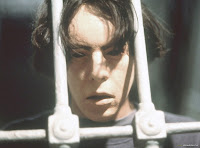
Upon returning to his large, foreboding house in the country, we discover that Louise is Dr. Genessier's housekeeper, and that his daughter Christiane is alive, living in hiding and wearing a creepy prosthetic mask to cover her disfigured face. I strongly believe that "Eyes Without a Face" was one of the sources of inspiration for "Arbre Los Ojos" (aka "Open Your Eyes"), the Spanish film that was remade as "Vanilla Sky". In these films, the main character is a rich and influential man who is horribly scarred in a car accident by a jilted lover and becomes a creepy masked recluse. While I am a fan of both films, neither the Spanish lead nor Tom Cruise wear the creepy mask as well as Edith Scob's Christiane.

Scob's Christiane is in a state of near-catatonic misery for the whole film. She's had her face torn off in an accident caused by her father driving like a maniac, and is then forced to hide herself away while her father holds a fake funeral for her. She is separated from her fiance, who thinks she's dead, and her only hope for a semi-normal life is her father's demented experimentation with skin grafting. Unfortunately for Christiane, her father's desire to recreate her face comes not from love or even guilt for causing her deformity, but out of a selfish desire to crack the mysteries of medical science. He keeps his daughter like a prisoner when he's not using her as a lab rat to test his latest ideas.

But Christiane is not the only person to suffer under her father's knife. Dr. Genessier has taken to kidnapping beautiful young women in order to steal their faces for Christiane's skin grafts. The body that Louise dumped at the beginning of the film turns out to have been an unwilling donor of a failed skin graft. Dr. Genessier promises Christiane that he's close to perfecting his technique, that soon she'll have a face again and be able to start a new life. Ironically, Christiane has been through so much pain that she would actually welcome death as an end to her suffering, but her father refuses to give up on her.
Genessier uses Louise to lure women to the doctor's house. She befriends them and tricks them into accompanying her to the mansion, where they are promptly drugged and their faces removed. Christiane has mixed feelings about her father victimizing girls in this way. She's hopeful that the experiments will pay off, resulting in a new beginning for herself, but is also painfully aware that for every girl Genessier kills, he takes only small steps towards a successful transplant. One of the faceless victims escapes only to commit suicide. At this point, Christiane starts sympathizing with the victims of her father's work, and decides that her life (or what's left of it) isn't worth the lives of others.

Because she can't resume her love life in any conventional way, Christiane has been making phone calls to her fiance Jacques and then hanging up without saying anything. Once, Christiane says his name into the phone, but is quickly cut off by Louise, who forbids her from contacting him again. This scene is actually enacted by the fictional theater troupe in "Ring 0: Birthday", the dramatic prequel to the Japanese Ring series. Sadako (who fans of the series will know is doomed to become a vengeful ghost) plays Christiane's part, and throughout the film, her acting troupe reenacts several scenes, most notably the "forbidden phone call" scene. "Ring 0" is a damned cool horror flick all by itself, but gets extra brownie points for referencing "Eyes Without a Face".

The phantom phone calls push Jacques to go to the police. A few sharp policemen have noticed a marked increase in the number of faceless women's bodies being found, as well as the fact that they all are proportionally similar to Genessier's daughter. When Jacques tells the police he suspects that his fiancee is still alive, they plan a sting operation to test Dr. Genessier. They find an attractive shoplifter named Paulette (played by silver-screen beauty Beatrice Altariba) to check into Genessier's clinic under the pretext of having migraine headaches.
Paulette is treated and discharged from the clinic without incident, but the police discover that after leaving the clinic, she never made it home. The police rush to Genessier's house. The bone-chilling finale is one of my favorite movie endings ever, and beautifully ties up the dark tale of the mad doctor and his faceless daughter.

I give "Eyes Without a Face" a 10/10, and that's only because it's the highest rating possible on my scale. Films like this tempt me to add a 10+ rating to denote truly spectacular films. I don't mean to gush, but this is one of the most beautifully-crafted, haunting horror films I have ever seen. It is nearly perfect in every way. The acting is top-notch, the story is worthy of Hitchcock, and the cinematography is just plain gorgeous. If you are even a passing fan of Hitchcockian suspense, you owe it to yourself to watch this film.


I also highly recommend: