Showing posts with label b-horror. Show all posts

Monday, April 12, 2010

I Bury the Living (1958)

Directed by Albert Band
Written by Louis Garfinkle

Unrated

"I Bury the Living" was a pleasant surprise. In spite of the cheesy title and sensationalized movie poster, "I Bury the Living" actually turned out to be a surprisingly modern thinking-man's (or woman's) horror film.

Richard Boone stars as Robert Kraft, a department store owner whose business interests place him next in line to be the chairperson for the Immortal Hills Cemetery.  Though he doesn't want the position, Bob quickly finds himself being shown around the Cemetery manager's shack by the thick-brogued Scotsman groundskeeper Andy McKee (Theodore Bikel).
Bikel and Boone as Andy McKee and Robert Kraft (left to right)

Andy shows Bob around the groundkeeper's hut. The two key fixtures here are a heater that doesn't work and a creepy wall-mounted map of the cemetery grounds. Andy explains that the plots with white pins stuck in them on the map indicate people who have reserved grave plots but are still living, while the black pins denote graves whose owners have died and been buried. As they are talking, a couple of young newlyweds come to buy a pair of adjoining plots. The groom explains that his inheritance will only pay out after he's bought a plot each for himself and his wife at Immortal Hills Cemetery, which I personally thought was an oddly morbid stipulation. Robert sells them the plots and puts some pins in the map to reserve their plots for them, but he accidentally marks them with black pins instead of white.
When Robert receives word a few days later that the young couple has died in a car crash, he begins to suspect that the map has some kind of supernatural powers. Half-disbelieving, he sticks a black pin at random into one of the plots on the map, removing the white pin that had been there before. When the owner of this plot turns up dead too, Robert becomes convinced that there is some kind of dark sympathetic magic at play.
Robert tries to tell his story to the cops, who receive it with cynicism and disbelief. The police are convinced that Kraft is just superstitious and that the deaths are coincidental. They cannot claim wrongful death without any evidence of such. Robert tries to tell his coworkers on the board at his department store about the map, but they tell him he's just paranoid. In order to put his mind at rest, Kraft's coworkers arrange a "test" of the map's powers. They choose a random person who has a plot at Immortal Hills, and get Kraft to replace the white pin with a black one. The board members promise that if anything happens to the owner of the plot, Kraft can resign as chairperson at the cemetery with no questions asked.
Of course something DOES happen to the man in question, but Kraft is beginning to realize that the map can't be killing people on it's own. Some of the Kraft Department Store board members have been chairpersons for the cemetery before Robert, and they reported using the wrong pin color on the map many times with no mishap. Robert begins to suspect that it is not just the map that is killing people, but that something dark within himself is turning the map into a deadly weapon.

Kraft's fellow board members tell him that he can resign if he wants to, but now Robert is too obsessed with the map and his dark powers to back out. He insists that he stay at the cemetery, so that no one else will use the murderous map. Though they are uneasy about the most recent death, the other board members propose a final test. Robert will place black pins in the plots of his fellow board members, including his uncle George, to prove once and for all that the curse isn't real. Robert protests, knowing that the black pins could mean death for his coworkers, but they insist. When all three men die, one by one, Robert is left the sole surviving member of the board.
At this point, enough people have died that even the police are willing to entertain Kraft's outlandish theory. They bring their own test to Robert: Put a black pin in the map on the plot of someone who is young, healthy, and currently in France. Robert tells the police plainly that to do so would mean the man's death. They accept responsibility for any consequences of their test, and force Robert to pin the plot. They reason that the other deaths all occurred in an isolated area, and that a death so far away would establish the range of the map's "powers". After doing the deed, Kraft calls Paris to talk to the man, only to be told by his wife that he's passed away.
At this point, Kraft's mental disorientation begins to be reflected in the editing. Stylish transitions and surprisingly modern editing techniques herald in Kraft's mental breakdown. The map seems to grow and distort, nearly filling Kraft's office. As he stares at the map, Robert realizes that if he has the power to take lives with the black pins, he should also be able to reverse the process with the white ones. Robert replaces all of the black pins of the people who'd died with white ones, and then lights a fire in the middle of the room and locks himself inside. But the fire burns out without catching the building ablaze, and Kraft suffers some smoke-inhalation, but is otherwise unharmed. Rushing out to the graves he'd marked, Robert is horrified and amazed to discover the graves empty.
 
Richard Boone at first struck me as a rather boring choice for the lead, but as the film progressed, he performed some powerful scenes that gradually earned him my respect. Theodore Bikel lays on the thickest Scottish accent I've ever heard, but gives an overall good performance as the disgruntled groundskeeper. I was very impressed with the way this film took full advantage of it's catchy premise. Everyone who learns of the map's power feels the need to test it for themselves, each "test" resulting inevitably in a death. The idea of a supernatural killing tool falling into the hands of a normal guy reminds me a lot of the manga/anime series "Deathnote", in which a smart high-schooler finds a notebook which allows him to kill anyone just by writing their name in it. Like "Deathnote", "I Bury the Living" takes a simple premise and then systematically explores all the different possibilities that this premise allows for. While the deaths in "I Bury the Living" are eventually found to be non-supernatural in origin, the dark psychology behind Kraft's assumption of guilt, and his hallucinatory descent into madness are what I found fascinating about this film.
I give "I Bury the Living" a 9/10. It is a surprisingly well-done b-movie that is in many ways ahead of it's time. Many of the transitions and editing techniques are so modern and stylized I'm surprised this film wasn't considered for any visual editing awards. The film features fine acting all around (with an extra pat on the back to Robert Boone) and the music is appropriately moody. For an evening of thrilling fun, watch "I Bury the Living" with a friend or two and a six-pack of good beer.


I also recommend:

Sunday, March 28, 2010

Stream Classic Films for Free at Mike's Movie Review Blog!

As those of you who read my reviews regularly probably already know, I have been imbedding full-length, streaming versions of the films I review in my blog posts whenever possible. In order to make it easier for you to find the film you want to watch, here is the current list of blog posts that include streaming videos of the films being reviewed with brief plot synopses:

"Asylum" - A horror omnibus starring Peter Cushing and Brit Ekland about an insane asylum whose inhabitants are not what they seem.

"The Brain that Wouldn't Die" - A super low-budget sci-fi flick about a mad scientist who will stop at nothing to keep his fiancee's severed head alive.

"Cat Girl" - Barbara Shelley stars as a newlywed who inherits a family curse from her dying uncle that brings out the cat in her.

"Corridors of Blood" - Boris "Frankenstein" Karloff stars as an addiction-prone surgeon who is desperate to discover a way to perform painless surgery.

"Curse of the Voodoo" - B-horror star Bryant Haliday stars as a British safari guide who is cursed by lion-worshipping African tribesmen.

"Devil Doll" - Bryant Haliday stars as "Vorelli the Great", an evil hypnotist/ventriloquist whose dummy assistant has a life of his own.

"Fiend Without a Face" - Atomic powers render a mad scientist's sheer thought into dangerous, alien brain-creatures.

"Night of the Living Dead" - The original George A. Romero zombie masterpiece, in all of its glory.

"Nosferatu" - An early, unauthorized adaptation of Dracula by German Expressionist F.W. Murnau (Blog entry is for the film "Shadow of the Vampire" (2000), but the video player for "Nosferatu" is at the bottom of the review page).

"The Terror" - A Gothic fairy tale starring Boris Karloff ("Frankenstein") and Jack Nicholson ("The Shining").

"White Zombie" - A very early zombie film starring Bela "Dracula" Lugosi as a zombie-making voodoo practitioner in Haiti.

The imbedded videos are towards the bottom of the review post pages, but feel free to skip the review, watch the film, and formulate an opinion on your own! The imbedded video players feature full-screen options so you can kick back, relax, and watch great movies on your computer. Some of the films have short commercials at the beginning and near the half-way point, but it's a small price to pay to watch classic movies for free online.

Friday, March 26, 2010

White Zombie (1932)

Directed by Victor Halperin
Written by Garnett Weston

Unrated

"White Zombie" is one of the many old films that have had their copyrights expire. I don't understand all the legal mumbo-jumbo, but essentially, this means they are public domain. Anyone with a print of this movie can duplicate and sell it with no copyright consequences. So go burn a copy today! It has also been made available to watch or download for free online.

"White Zombie" is the great-grandaddy of zombie movies and the inspiration for the name of Rob Zombie's first band. Fans of modern zombie films may expect something resembling "Night of the Living Dead", but "White Zombie" has its own unique take on the zombie theme.
The film revolves around Madeleine Short (Madge Bellamy) and her fiance Neil Parker (John Harron), who are on their way to get married in Haiti when their carriage is stopped in the middle of the road by a native funeral. Their driver explains that in Haiti, people bury their dead close to or under well-traveled roads to protect them from corpse thieves.
"White Zombie" actually sticks closer to the origin of real-life zombies than the bulk of zombie fiction. The roots of zombie mythology lie in the Haitian practice of punishing those who commit crimes against their communities by poisoning them with a drug (usually containing tetrodotoxin, which is found in blowfish poison) that causes them to appear medically dead for anywhere from 8 hours to a few days. The victim is buried, and then dug up later and forced to work on a "zombie plantation", where the victims are forced to work as slaves, and are kept perpetually drugged to keep them docile and prevent escape.
Madeleine and Neil soon encounter the owner of a zombie workhouse, "Murder" Legendre (the fantastic Bela Lugosi) who approaches their carriage with a group of his zombie slaves as the lovers pass. The driver hurries on, terrified, but not before Legendre develops a creepy obsession with Madeleine. He grabs a scarf from around her neck through the carriage window as the lovers continue on into the night, a lurid memento of his brush with beauty.
 Madge Bellamy as Madeleine in her unflattering bridal undies.
Madeleine and Neil are en route to be married at the house of Charles Beaumont (Robert Frazer), a friend Madeleine met while traveling. What they don't know is that Beaumont has also fallen in love with Madeleine, and will do anything to keep her for himself. He invites the young couple to be married in his house, then tries to dissuade her from marrying Neil even as he's walking her to the wedding. When she marries him anyway, Beaumont goes to see "Murder" Legendre himself to ask his help in obtaining an unwilling bride.
Legendre informs Beaumont that the only way to make Madeleine forget her love for Neil is to make her into a zombie. Beaumont is initially disgusted by the idea of turning the object of his affection into a brainless slave, but is willing to go to any lengths to make her his bride. Beaumont follows Legendre's instructions, putting a pinpoint of the powder on a flower which he gives Madeleine on her wedding night.
Using the scarf he stole from her by the carriage and a candle carved into the shape of a woman, Legendre channels that good-ol'-fashioned Hollywood voodoo to steal Madeleine's soul. She becomes suddenly ill, and collapses as though dead. Neil mourns in a whiny manner and an immediate funeral is arranged. After the funeral, Beaumont, Legendre and his band of zombies descend on Madeleine's coffin, stealing her body away back to Beaumont's estate.
Neil has a hard time giving up on his dead newlywed, especially when he learns of the Haitian practice of zombie-making. With the help of a doddering old minister (who keeps annoyingly asking the main characters for a match to light his pipe), Neil heads for Beaumont's castle to face Beaumont and Legendre directly. On his way, he and the minister rest for a bit at the base of the mountain that castle Beaumont sits atop. At this point, the filmmakers use an interesting image layering effect to show Madeleine on a balcony looking out, the castle, and Neil at the same time. I was struck by this experimental editing technique. In conjunction with sappy music, this scene conveys a sense that the lovers share an emotional connection that is stronger than Legendre's voodoo hypnotism.
Meanwhile, Legendre uses some of his zombie powder to paralyze Beaumont. He then explains that he did not make Madeleine a zombie for Beaumont's sake, but intended to keep her as his own bride. Neil races to the castle to save Madeleine, but can Legendre and his small army of bug-eyed zombies stop him?
 
I gave "White Zombie" a 6/10. It moves along slowly enough to bore most modern audiences (though was probably quite thrilling at it's original release). The filmmakers use interesting editing effects to spice up the visuals. Many of the beautiful, gothic sets were originally built for other big-budget horror films of the same period, like "Dracula" (1931), "Frankenstein" (1931) and "Hunchback of Notre Dame" (1923). Bela Lugosi himself is creepy as always as "Murder" Legendre. Unfortunately, like many of his post-"Dracula" roles, this one keeps him in a fairly tight two-dimensional gothic villain typecast and doesn't give him much opportunity to exercise other aspects of his acting talent. Madge Bellamy is catatonic for most of the film, but she does that well enough. She's got a cute zombie-face. As a zombie film, "White Zombie" may disappoint, but only because it bears so little resemblance to the zombie films of later years. For hard-core zombie junkies or avid fans of Mr. Lugosi, "White Zombie" is a must-see. Watch it here for free:


I also recommend:

Friday, March 19, 2010

Inseminoid (1981)

aka "Horror Planet" USA

Directed by Norman J. Warren
Written by Nick and Gloria Maley

Rated R for sexual violence, nudity and gore.

"Inseminoid" is one of four films I recently purchased in a 4-Film British Horror Pack. Other films in the set are: "Curse of the Voodoo", "Horror Hospital" and "Tower of Evil" (click links for reviews).

"Inseminoid" is one of many sci-fi films from the early 80's to attempt to cash in on the success of Ridley Scott's "Alien". While it doesn't have the awesome sets, the amazing acting, or the iconic xenomorph alien of "Alien", "Inseminoid" manages to be surprisingly entertaining considering the film's obviously low budget. It is hard not to laugh at parts of this film, but it also has moments of genuine horror.
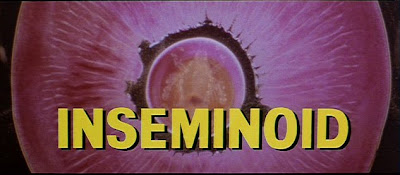
After some groovy, retro, spaced-out opening credits, a female narrator informs us that a ship has been exploring a planet that was once inhabited, but has since been abandoned. Some might criticize a film for using voice-over narration so heavy-handedly, but in all fairness it's less cheesy than the opening rolling text narration of the "Star Wars" films or the dense, confusing voice-over narration in "Dune". We then see two men in spacesuits exploring the planet. They stumble on a series of caves and split up to investigate (always a bad idea in this type of movie). One of the explorers discovers a pile of crystals which he examines. By the time his teammate returns, the first man has been rendered unconscious by the crystals, which have eroded through his glove and skin and infected his bloodstream. The infected team member is brought back inside the atmosphere-controlled headquarters of the crew, where we meet about a dozen crew members who we will later see killed in bizarre and extraordinary ways.
The crew tries to go about their work in spite of the accident, but Ricky, the infected man, begins to behave violently. He dons a spacesuit and goes back out into the planet's caves, apparently being controlled by the alien crystals, and attacks anyone who tries to stop him. He leaves one half of the air-lock open so that the other team members can't follow him. Ricky pushes rudely past another crew member exploring the caves, and the woman (I think the character's name is Gail) stumbles and gets her foot caught in some kind of metal debris. Now what happens next was like a precursor to the "Saw" films. Gail's suit's heating unit goes out abruptly, leaving her with no protection against the -80 degree F alien planet temperature. A male teammate tries to talk her through the repair of the unit by radio (which is apparently as easy as crossing a few wires), but Gail just panics and is completely useless. As a last resort, Gail opens her face-mask (!?!?) and puts one of the air-tubes from her suit directly in her mouth. She then whips out a hedge trimmer and tries to cut off her caught foot. Sadly, Gail's incompetence proves deadly to her. While completely absurd, this is one of the more interesting death scenes in the film.
 
"Gail. You've spent your whole life relying on the men around you to fix things. Now, in order to survive, you're going to have to help yourself. Your foot is trapped in some scrap metal. Your thermal unit is broken. You have three minutes to free yourself and get to the airlock before you freeze to death. Do you have enough of a grasp of basic electronics to cross the wires that will return power to your thermal unit, or will you cut off your leg with a hedge trimmer? The decision is yours."

Kate, another crew member, is now trapped alone (unless you count Gail's body) in the caves with infected Ricky. He tries to stop her from closing the airlock, so she shoots him, killing him instantly. She actually catches some flak from her teammates for not trying to find a non-fatal way to stop Ricky, which just goes to show you can't make everyone happy. Luckily for the crew, the mayhem appears to have subsided... for now... In spite of the team's incredibly low survival rate in the caves, two more team members are dispatched to continue explorations. This time, perky young Sandy (Judy Geeson) is paired with the only black guy in space, who is promptly torn to pieces in front of her by an unseen assailant. Sandy passes out only to awaken on some kind of laboratory table, stripped completely naked.
While lying prone and helpless, Sandy is given an injection by the ship's doctor, whose presence in this strange alien lab is a bit of a mystery. The best interpretation I've found is that he is actually trying to get one of the crew members pregnant with an alien baby as part of a dark conspiracy to bring alien subjects back in utero to the company they all work for. There isn't much evidence for this theory outside of this scene, but something similar happened in "Alien", so I assume the writers were thinking along these lines.
The following scene is the one for which this film has gained the most fame and notoriety. The "Inseminoid" alien finally makes an appearance. He is a comically grotesque, penis-shaped lobster-man who pops up between Sandy's open legs as if to say "Daddy's home and it's time for love!"
Big Papa Lobster wastes no time with foreplay. He slides what appears to be a monstrous turkey baster filled with creepy eggs and green liquid into Sandy and begins to pump his love-beasts into her womb. This tube scene is one of the best scenes in the movie for raw, visceral creepiness. It is also the scene which has inspired the most controversy.
When Sandy wakes up again, she's back in her team's base with the doctor and her other worried crewmates. Apparently she's two months pregnant, which is impossible as she'd been taking regular birth control injections. I guess human birth control can't hold back the virulent Lobsterman seed. As she gets more and more pregnant (which happens at an alarming rate), she becomes possessed by her alien spawn and begins killing and feeding on her teammates.
Up until her character's alien insemination, Judy Geeson hadn't had much opportunity to really act. While I wouldn't rate her among the best actresses ever, Geeson's performance in the second half of "Inseminoid" is really what carries the movie. Her intensity and craziness reach a fevered pitch quickly and keep building from there. One of her team members remarks "Well, that'll look good on the report: the team were terrorized by an expectant mother." It's a lot scarier than it sounds. The surviving crew members dwindle as Sandy strikes again and again, mercilessly slaughtering her friends and coworkers. In the end, she is finally strangled to death by her boyfriend Mark, but not before giving birth to TWINS!
I give "Inseminoid" a 9/10. It is quite possibly the most entertaining "Alien" rip-off ever made. It is serious enough to be genuinely thrilling, and contains images that are pure sci-fi gold. "Inseminoid" may even have surpassed "Alien" in terms of pacing. I dearly love Ridley Scott's original sci-fi masterpiece, but it sure did move along slowly. I cannot recommend "Inseminoid" if you are an expecting mother, uncomfortable with depictions of alien insemination or dislike cheesy b-horror films. If you enjoy bizarre, obscure b-movies, track down a copy of "Inseminoid" ASAP.


I also recommend:

Wednesday, March 17, 2010

Tower of Evil (1972)

Directed by Jim O'Connolly
Written by George Baxt and Jim O'Connolly

Rated R for bloody violence and lots of nudity.

"Tower of Evil" is part of a British Horror 4-Film Box Set I recently purchased. Other films in the set include "Curse of the Voodoo", "Horror Hospital", and "Inseminoid" (review still to come).

I've read a few other reviews of "Tower of Evil" while looking for good screenshots, and found a wide divergence of reactions to the film. People either love it or hate it. I fell somewhere in between. I feel like there are some promising elements in "Tower of Evil" that were never fully fleshed out. Perhaps it's due for a re-make?

"Tower of Evil" is what John Carpenter's "The Fog" would have been if it had been made by pervy British hippies on a shoestring budget. During the opening credits, the "helicopter shot" of a lighthouse is clearly just a camera tracking around a shoddily-constructed model of a lighthouse. I'm not against using models, but if you're going to try and con a theater-full of people into believing your model is a real building, it had better be a damned good model.

Through the fog, we see two fishermen sailing towards the lighthouse. They have a brief, cryptic conversation about how they need to do something about the island, and it's long overdue. Upon arriving, they are shocked to find a nude male body lying facedown in a puddle being fed on by carrion crab. They proceed to the main building and discover a man in a butterfly shirt impaled on the wall with a large, golden scepter of some sort. You may recognize this actor (Robin Askwith) as Jason Jones from "Horror Hospital".
As they proceed through the building, the fishermen find a naked woman, with her hair covering her face, lying dead on the floor. They try to brush the hair out of her face, but her head falls off entirely and rolls down the stairs. The older of the two fishermen opens a closet to discover a nude, crazy girl (Candace Glendenning) who promptly stabs him with a sharp stick, killing him. She runs naked in the fog for a bit and then gets conked on the head by the other fisherman.
The police bring the crazy naked lady to the mainland for questioning, a task which is made more difficult by the fact that she's slipped into some kind of catatonia. Luckily, Dr. Simpson has a psychedelic seizure-inducing light show that reputedly reactivates dormant minds long enough to ask them a few questions. While psychology in film is seldom very true to life, this arrangement is particularly unbelievable. I'm guessing that a significant portion of the budget for this film was spent on hallucinogens. "A bank of colored lights that flashes in pretty patterns? Groovy! That sounds pretty scientific to me!"
The treatment miraculously works, triggering a series of disconnected memories from the girl, whose name we discover is Penny Read. Her flashbacks reveal that she had been on the island with her boyfriend and two other hippie teens. Penny's female friend has bad vibes about the island, but the others ignore her. They smoke grass and walk around naked in true "free love" spirit until they are killed off one by one by a man with long fingernails who appears to be smeared with his own excrement. At this point, Penny begins to have some kind of seizure and they have to turn Dr. Simpson's Funkadelic Groove Machine off for a while to let her rest.
Meanwhile, an expedition to the island has been mounted by some archeological folks who are looking for a hidden Phoenecian treasure trove. They believe the golden scepter that they found is one of many treasures buried in a tomb somewhere on the island. A private detective, Evan Brent (played by Bryant Haliday of "Curse of the Voodoo" and "Devil Doll") accompanies them to find out who was responsible for the killings. 
Bryant Haliday as "The Great Vorelli" in "Devil Doll" (1964).
Now Bryant is normally a pretty good b-movie actor. The previous movies I'd seen of his were both black and white, and I was saddened to see that he didn't transition to color very gracefully. His face, which is pock-marked and blotchy, looked great in black and white. In color, Haliday looks like an overcooked sausage. His role in this movie is too small to really offer much opportunity to amaze us with his acting skills. For Haliday at his strongest and most intense, check out "Devil Doll".
 Evan Brent (Haliday) and Brom (Gary Hamilton) on the way to the island. 
The archeologists who accompany Brent to the island are the worst possible teammates for a dangerous expedition. They consist of two men and two women who have nearly all had romantic relationships or slept with one another. The bitterness between the four makes for funny dialogue, but they're ultimately pretty poor characters. On their way in, they remark that there are no gulls or birds of any kind on the island (a clever cover for the fact that most of the "island" footage is clearly shot in a studio, where there would be no birds).
The two ladyfolk archeologists are both shagadelic, and tease the boys mercilessly with their wiles. In the meantime, Evan Brent reveals that he believes there to be a system of caves underneath the island that are the probably resting spot of the treasure. The treasure is guarded by a statue of Baal, a god who the Phonecians worshipped with orgies and blood sacrifices. Unfortunately, Saul, the former lighthouse keeper, is also somewhere in the caves under the island. You see he's gone totally insane following the deaths of his wife and son, and now lives in squalor, attacking anyone who sets foot on the island. It is implied that Baal is somehow connected to Saul's craziness and the island's abnormally high fatality rate in general, but a clear connection is never drawn.

And so the stage is set for what can only be a very silly finale. I won't give away too much about the ending, but the film stays fairly true to the classic slasher film formula. What it lacks in coherence and quality writing, "Tower of Evil" makes up in bloody horror and gratuitous nudity.
I'd give "Tower of Evil" a 6/10, which I'm sure some would say is a generous rating. It's a film with a lot of great elements that was just put together in a less-than-ideal manner. The pacing, the acting and the low production value really robbed this movie of being what it could have been. There are some truly frightening images in the film (like a really creepy family portrait of Saul with his wife and baby) that periodically renew one's interest in the film interspersed with overlong scenes of badly written (and acted) dialogue. Overall, I'd steer clear if you're a casual horror fan, and check out the campy fun of "The Satanic Rites of Dracula" or "Horror Hospital" instead. If you're a brit-horror nut, it may be time to take your own trip to the "Tower of Evil".


I also recommend:

Monday, March 15, 2010

Horror Hospital (1973)

Directed by Antony Balch
Written by Antony Balch and Alan Watson

Rated R for violence and nudity.

"Horror Hospital" is part of a British Horror four movie box set I recently purchased. Other films in the set include "Curse of the Voodoo", "Inseminoid" and "Tower of Evil" (reviews still to come).

"Horror Hospital" stars Michael Gough as the demented Dr. Storm, who runs a health resort/hospital that "cures" its patients by lobotomizing them, turning them into brain-dead zombies. Gough is a veteran actor and has been in countless movies. Most notably, Gough was Bruce Wayne's butler Alfred in the Batman films of the 80's and 90's. While Gough's performance in "Horror Hospital" is nothing particularly special, it is interesting to see such a skilled actor in such a ridiculous b-movie.
The film opens with Dr. Storm sitting in an idling limousine with his midget servant, Frederick. As we watch, a young man and woman with bandaged, bleeding heads runs out of the woods. Dr. Storm guns the limo, pursuing them. On Dr. Storm's command, Frederick pulls a lever that causes a large blade to jut out of the side of the limo at neck-level, instantly decapitating the two escapees and catching their heads in a conveniently-placed canvas sack. That's right, folks; a decapitating limousine, the new standard of excellence for wealthy sociopaths.
Jump to London, where Jason Jones (Robin Askwith) sits dejectedly in a smokey night club. Jason looks like a mean, British, hippie version of Mark Hamill. He gets into a brief fistfight with a transvestite over a song that he says the tranny's band stole from him. When the tranny beats him (it's embarrassing to be overpowered by a man in a curly platinum wig and lipstick), Jason finds a group of his friends to comfort him. One of Jason's friends looks like an evil John Lennon. If you watch the film, you'll know who I mean. To make a long story short (too late for that) Jason's friends suggest he goes on a "hairy holiday" they see advertised through a travel agency. Jason agrees he needs some time away from the music scene, and embarks for a holiday in the British countryside.
On the train, Jason meets Judy (Vanessa Shaw), a quiet girl who he clumsily attempts to charm ("Don't worry. I'm not going to rape you."). Oddly enough, Jason's abrasive personality apparently rubs Judy the right way. Realizing they're going to the same place, they become travel companions.
When they arrive at Storm's hospital, they sit down to eat dinner with dozens of other young hippies who have already received the "Storm" treatment. They are pale, silent and expressionless, and each sports a fresh surgery scar on their left temple. Jason and Judy are immediately put off by the hospital and its catatonic patients, but Judy's creepy Aunt Harris (who is also Dr. Storm's assistant) tells them the hospital grounds are already closed for the evening and there's no way out. Jason and Judy decide to stay the night and make the best of it. In classic 70's horror movie style, making the best of it means having sex. Lots of sex. Afterwards, the pair decide to snoop around the hospital grounds a bit, and are horrified to discover that Dr. Storm is actually lobotomizing his patients to make them thoughtless drones.
As Jason and Judy struggle to find a way out of the hospital, bodies begin piling up. The travel agent who referred Jason to Dr. Storm wants more money for his services, so Storm has him decapitated. Aunt Judy tells Storm she won't help him with any more demented surgeries, and she gets attacked by a giant, melting flesh-monster. It seems anyone who crosses Storm comes to a bad end. He even has an army of ineffectual, unarmed guards in helmets who look like gay motorcycle enthusiasts. Dr. Storm's "Storm troopers" can't have been chosen for their strength, because they are constantly being overpowered by weak-looking hippie teens. Good thing they were wearing their helmets.
Jason and Judy are soon joined by Abraham (Kurt Christian), who is looking for his runaway girlfriend Millie. Unfortunately for Abraham, Millie has already received Dr. Storm's treatment, and is already a mindless slave. Terrified and desperate to escape, the three hippies make their way through Dr. Storm's hospital of horrors, discovering along the way the terrible secret behind Storm's psychotic surgeries
I give "Horror Hospital" a 7.5/10. I should say right up front that "Horror Hospital" is a terrible movie. If you're looking for a cinematic masterpiece, look elsewhere. Having said that, it's (perhaps unintentionally) one of the funniest horror movies I've ever seen. From the decapitation limo to Frederick the creepy midget, there's no lack of campy fun. There are also plenty of decent nude scenes (even some rare 70's male nudity) for discerning pervs and pervettes. While the story is patently ridiculous, there are actually some genuinely creepy images in this film, and the cinematography is at times surprisingly good. Watch this film with a six-pack of cheap beer and friends who appreciate low-brow humor.


I also recommend:

Thursday, March 11, 2010

Fiend Without A Face (1958)

Directed by Arthur Crabtree
Written by Herbert J. Leder and Amelia Reynolds Long

Rated PG for smoking and monster violence.

"Fiend Without a Face" is yet another classic B-horror film available to view online for free at AMCTV.com. Watch it for yourself here.

"Fiend Without a Face" stars Marshall Thompson as Major Jeff Cummings, an Air Force investigator stationed out of an experimental Air Force base on the US/Canada border that uses atomic power to boost radar signals. The locals have been complaining that the jets flying by overhead have affected the livestock on their farms. The cows aren't giving as much milk as before, and the locals blame the Air Force base and atomic fallout for their troubles.
Things get worse for Major Cummings when Griselle, a local farmer, is found dead with an expression of pure horror on his face. The townsfolk at first suspect some kind of fatal atomic poisoning, but are stumped when they learn that the dead farmer's brain and spinal column have been sucked out of his body through two small holes in the back of his head, a medical impossibility.

Major Cummings is called to investigate the death, both to solve the crime and to prove to the townsfolk that the Air Force isn't responsible. He questions Griselle's lovely sister, Barbara (played by the sensual Kim Parker), who works as a secretary for the reclusive Professor Walgate. Jeff and Barbara are clearly attracted to one another, but are initially put off by their first impressions of one another. Barbara clearly identifies more with the townfolk (many of whom are calling for the Air Force Base to be permanently shut down) and only grudgingly allows the sexy Air Force Major to charm her. In one particularly hot scene, Jeff arrives at Barbara's house when she's in the shower, surprising her. I know she's probably very old or dead now, but I can't help being very turned on by coy Kim Parker in a towel. So cute!
As Jeff and Barbara investigate, more mysterious deaths crop up. In one instance, a man is left alive, but completely brain-dead. The townsfolk become more paranoid and begin to roam the streets with guns, looking for the killer. What they don't know is that the killer isn't atomic fallout or some American Air Force officer gone on a blood-thirsty rampage, but invisible creatures of pure thought created by Professor Walgate, who used the Air Force's atomic power as fuel for his depraved experiments. The creatures take over the atomic plant, making it impossible for the Air Force to cut off their source of power. When they boost the power to danger levels, the creatures become visible.
Perhaps the films' greatest success is the brain-creatures themselves. Insect-like, fast, and brain-sucking, these stop-motion creatures are rather terrifying even today. The animation effects used to make them move are very well done, and when they're killed, they explode with spurts of blood that Tarantino would be proud of. I believe the brain creatures from "Fiend Without a Face" are direct cinematic ascendants of the face-huggers from the "Alien" series.
The film's conclusion is violent, bloody, and explosive. Cummings finds a very scientifically unsound way to shut down the power plant (don't try this at home), but will he execute his plan in time to save Barbara and the other survivors?

I give "Fiend Without a Face" an 8/10. It's a little slow-moving at times, but strong performances, great special effects, an explosive finale and Kim Parker in a towel make this a must-see for fans of B-movies. This film was obviously made on a relatively small budget, but manages to get a lot of "bang" for it's buck. A spirited, funny cult classic for monster movie fans. Watch it for free right here:


I also recommend: