Wednesday, April 7, 2010

Skeleton Man (2004)

Directed by Johnny Martin
Written by Frederick Bailey

Rated R for violence and brief language, as well as just being a horrible film.

"Skeleton Man" is part of a horror film 4-pack I bought last year. It is without a doubt one of the worst horror films I have ever seen.

The premise is that a Native American warrior went bat-shit insane and slew his whole tribe. Then, as a supernatural ghost in a polyester cape and cheap Halloween mask, the Skeleton Man terrorizes the worst actors in Hollywood. The first time I watched this, I was half-convinced that it was actually an elaborate ironic satire on bad filmmaking. Upon rewatching it, I realized that it's just a uniquely terrible film.
What made this film worth chuckling at for me is that it's so badly done that most first-year film students could do better. As a filmmaker myself, I puzzled at the terrible editing choices again and again. Half a dozen times throughout the film, I noticed areas that looked unfinished in terms of editing. The title animation looks like a failed demo of crappy 90's CG blood effects. At one point, instead of showing a clip of the moon, they inserted a grainy still-frame of the moon. You know filmmakers are lazy when they intersperse low-quality still photography instead of getting a five-second shot of the moon.
If the bad editing weren't enough, the story is comically bad. After the Skeleton Man attacks some archeologists digging up Native American artifacts, he terrorizes workers at a chemical plant, and then takes out a team of special forces soldiers. There is no attempt made whatsoever to connect these scenes other than that Skeleton Man is in all of them. What they establish in terms of plot (other than a lack thereof) I have no idea.
A second team of soldiers is called in, and for some reason, the back-up team incomprehensibly consists of mostly attractive girls. As the characters are introducing themselves, titles pop up on-screen to further introduce them. It's redundant and sloppy. The character says "Hi, I'm Davis. Underwater Demolition Specialist," and as she's speaking, the words "Davis - Underwater Demolition" pop up below her. There is no reason to use titles to introduce characters EVER. And if you do, there is even less reason to have the characters verbally reiterate something the title has already told us. I am confused as to why Davis was brought on the mission at all. There are no bodies of water featured in Skeleton Man.
After quite a bit of awful dialogue amongst the "soldiers" (I can't even type it without using quotation marks), the team begins to sweep the area of forest where the first team disappeared. They quickly encounter an old, blind Native American who tells them the myth of the Skeleton Man in exchange for a can of army surplus beans, which he eats cold as he speaks. I am not Native American, but I am offended on their behalf by their sordid representation in this film. It is clear to me that no self-respecting Native American will ever be able to watch this film without shedding a single tear. The Skeleton Man fights with a spear, a bow and arrow, an inappropriately medieval-looking broadsword, and a giant spear, each of which he appears to have stored in his rectum because he just whips these giant weapons out of nowhere at a moment's notice. He rides around on a horse wearing a polyester cape and a cheap Halloween mask. I have always had a deep hatred for any film that uses cheap rubber masks instead of make-up effects. I'm pretty sure you can buy the "Skeleton Man" mask at Fred Meyers for about 10$ around Halloween-time. Not that you'd want to.
Finally, the Skeleton Man begins picking off the "soldiers" one by one. He appears at random out of bad CG vortex-like ripples in space, which seems more science fiction than ghostly to me. He kills most of the group without much effort, eventually narrowing it down to Lt. Scott (the attractive Sarah Ann Schultz) and Captain Leary (Michael Rooker, the recipient of an infamous "chocolate covered pretzel" in Kevin Smith's "Mallrats"). Leary spends the rest of the film trying to blow the living shit out of the Skeleton Man with his seemingly endless supply of explosives.
I give "Skeleton Man" a 3/10. My ongoing quest to watch and review movies sure does lead me to some strange places. I'm sure there's some film out there worse than "Skeleton Man", but I haven't found it yet. The death scenes are so over-the-top that they're occasionally funny (like when the Skeleton Man hits one of the "soldiers" so hard that he does a backflip), but there are thousands of better films to watch. The only way I can recommend this film is if you are a struggling amateur filmmaker and want to feel better about your chances of directing a big Hollywood movie. If some studio let Johnny Martin use their money to make this terrible, laughable film, then there's a chance for all of us.

Buy "Skeleton Man"? (I wouldn't if I were you!)


Or check out these much better films:

Tuesday, April 6, 2010

The Terror (1963)

Directed by Roger Corman
Written by Leo Gordon and Jack Hill

Rated PG for frightening imagery and situations.

"The Terror" is one of many old films that are now public domain. This means that anyone with a copy of this film can reproduce and even sell it with no copyright penalties. So go burn a copy today! "The Terror" has also been made available to watch or download for free here.

In addition to being free, "The Terror" also boasts the unlikely pairing of Boris Karloff and Jack Nicholson in the lead roles. For fans of Karloff's later work and Nicholson's earlier work, "The Terror" should be a special treat!

The film opens with a really neat animation sequence featuring ghostly images flying around cartoonish Gothic architecture to intense instrumental music as the opening credits play. This animation reminded me of the credit sequences of old Warner Brothers' cartoons. At it's heart, "The Terror" is a Gothic fairy tale, and I feel the opening animation does an excellent job of setting the mood.
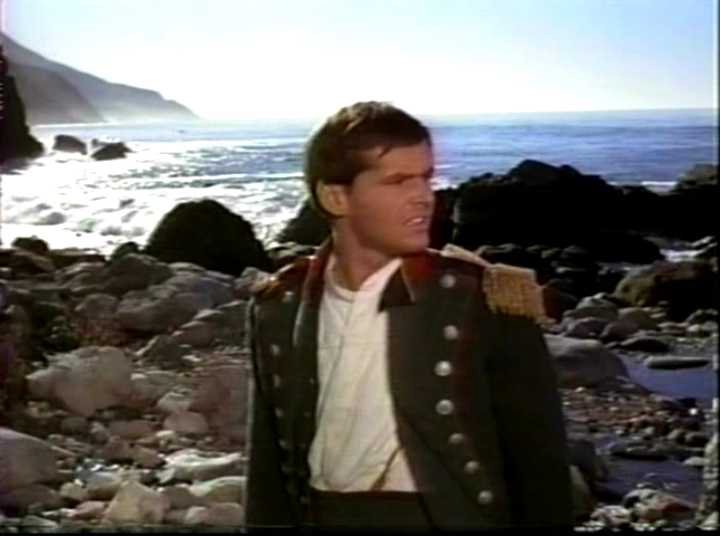
Jack Nicholson stars as Andre Duvalier, a lieutenant in Napoleon's army who has been separated from his regiment and wanders along an anonymous beach, close to exhaustion. Just as he's near losing consciousness from heat-stroke, he meets Helene (Sandra Knight), a beautiful young woman who helps him find fresh water and flirts with him mercilessly. Suddenly, Helene starts walking straight into the ocean. Andre tries to rescue her, but nearly drowns himself, and is attacked by a malicious falcon as he struggles against the strong current. Apparently Jack Nicholson's performance here wasn't all acting. The actor later revealed that he almost drown himself when this scene was being filmed.
Duvalier awakens in the cottage of Katrina (Dorothy Neumann), an old woman so ugly she can only be a witch. Katrina claims to have rescued Andre from the ocean, and that she knows nothing about a girl in the area. When Andre is well enough, he sets out to explore the area. He quickly encounters Helene (Sandra Knight) and follows her into the forest. As he chases after Helene, Duvalier is grabbed by a young local named Gustaf. Gustaf explains that the ground Duvalier was headed towards is deadly quicksand. Andre remarks "She tried to kill me". Gustaf cryptically responds "It's not her fault. Her will is not her own". Gustaf reveals that the girl lives at the castle of the reclusive and long-named Baron Victor Frederick von Leppe (Boris Karloff).
Baron von Leppe, like every truly nefarious Gothic noble, lives in a beautiful Gothic castle perched on a cliff. Upon his arrival, Andre sees Helene looking out of one of the castle's windows. Andre knocks on the large front door and is greeted by Baron von Leppe himself, who assures him that there is no woman in the castle. Andre demands (quite rudely, I might add) to stay the night at the castle instead of one of the village inns. The Baron grudgingly obliges. Once inside the lush castle, von Leppe shows Duvalier an old painting of a beautiful woman who bears a striking resemblance to Helene. The Baron suggests that perhaps Andre saw the painting through the window and mistook it for a living girl. The woman in the painting is the Baron's late wife, the Baroness Ilsa von Leppe. Uncertain how to proceed, Duvalier settles in for the night, making himself at home in the Baron's creepy castle.
Andre awakes during the night to find Helene walking through the moonlit graveyard under the window to his room. He follows her. She leads him to the entrance to the tomb of the Baroness von Leppe in the crypt under the castle and then disappears. [An interesting historical goof: Nicholson carries a snub-nosed revolver with him as he creeps around the castle. Revolvers weren't invented until several decades after the film is set, and the snub-nosed version wasn't really seen in Europe at all, but in the American West.] Again confounded by the hot but elusive Helene, Andre has every intention of taking his horse and leaving the area, but is told that his horse has escaped during the night and is missing. Enraged, he takes his anger out on the Baron's butler, Stefan. Stefan assures Duvalier that he will get him a new horse as soon as possible ("Believe me, Lieutenant, I have no desire to interfere with your departure from this castle."), but for the time being, Andre is stuck in the decrepit mansion.
One of the highlights of this film is watching Jack Nicholson be incredibly rude to people. Long before Jack Nicholson was the great actor we now know him to be, he had a great talent for being arrogant and abrasive on film. In "The Terror", Nicholson is almost a one-note pony. He goes from horny to insensibly angry and back to horny again with little provocation.
Unable to find Helene or any explanation for the mystery surrounding her and the castle, Duvalier confronts Baron von Leppe, demanding answers. After a bit of resistance, von Leppe tells the story of his meeting with his wife, Ilsa. She was a peasant girl. By all rights, in those times, a Baron could have "claimed" her as his own without any problems, but he chose to court her and woo her instead. He went off to fight in a war, and when he returned, he found a man named Erik with Ilsa in her bed. Baron Victor tells Duvalier how he murdered Ilsa in a rage, and how Stefan "took care of" Erik. Haunted by his past and miserable, the Baron reveals that he's seen Ilsa several times since he killed her, and that he looks forward to her occasional hauntings because he gets to see her again.
Things become further confused when Duvalier discovers that Katrina the witch is using Helene to channel the spirit of the dead Baroness in order to push the Baron to suicide. Why would she go to such lengths to punish the Baron? What is Katrina's connection to Erik, the dead Baroness' lover? In a thrilling twist-ending, Roger Corman turns our expectations on their heads to unveil the shocking truth about the von Leppes.

"The Terror" is not driven by excellent writing, acting or plot. It is more of an atmospheric horror piece, akin to "Night of the Living Dead" or "Carnival of Souls". That is not to say that acting, writing and plot aren't there, they just take a back seat to the slow-burn terror of "The Terror". Karloff (who at this point in his career was declining in popularity) gives a good performance as Baron von Leppe, and Nicholson is adequate as Andre Duvalier, but neither of them are at their peak.

The locations used in the film are almost surreal. All of the sets were left-overs from "The Raven", another Corman production. "The Terror" is rumored to have been shot mostly in the four days following the completion of filming on "The Raven". Corman used the sets as much as possible before they were torn down. The rest of the film was pieced together patch-work by several other filmmakers who collaborated to complete Corman's vision. These included a young Francis Ford Coppola and Jack Nicholson himself. What results is a varied tapestry of plot threads that actually go together quite nicely.

I give "The Terror" an 8/10. It's haunting, beautifully-shot, and genuinely entertaining. I got a 1$ copy of this DVD at the Dollar Tree and it was well worth it. The low-quality video and audio added to the film's nostalgic fairy-tale creepiness. The story is engaging and intelligent (though the plot falls apart a little under scrutiny), and the visuals are breath-taking. So if you're a fan of Gothic horror, fairy tales or ghost stories, stop what you're doing right now and watch "The Terror" for free online:


Like it enough to buy it?


Also check out these other great films:

Sunday, March 28, 2010

Stream Classic Films for Free at Mike's Movie Review Blog!

As those of you who read my reviews regularly probably already know, I have been imbedding full-length, streaming versions of the films I review in my blog posts whenever possible. In order to make it easier for you to find the film you want to watch, here is the current list of blog posts that include streaming videos of the films being reviewed with brief plot synopses:

"Asylum" - A horror omnibus starring Peter Cushing and Brit Ekland about an insane asylum whose inhabitants are not what they seem.

"The Brain that Wouldn't Die" - A super low-budget sci-fi flick about a mad scientist who will stop at nothing to keep his fiancee's severed head alive.

"Cat Girl" - Barbara Shelley stars as a newlywed who inherits a family curse from her dying uncle that brings out the cat in her.

"Corridors of Blood" - Boris "Frankenstein" Karloff stars as an addiction-prone surgeon who is desperate to discover a way to perform painless surgery.

"Curse of the Voodoo" - B-horror star Bryant Haliday stars as a British safari guide who is cursed by lion-worshipping African tribesmen.

"Devil Doll" - Bryant Haliday stars as "Vorelli the Great", an evil hypnotist/ventriloquist whose dummy assistant has a life of his own.

"Fiend Without a Face" - Atomic powers render a mad scientist's sheer thought into dangerous, alien brain-creatures.

"Night of the Living Dead" - The original George A. Romero zombie masterpiece, in all of its glory.

"Nosferatu" - An early, unauthorized adaptation of Dracula by German Expressionist F.W. Murnau (Blog entry is for the film "Shadow of the Vampire" (2000), but the video player for "Nosferatu" is at the bottom of the review page).

"The Terror" - A Gothic fairy tale starring Boris Karloff ("Frankenstein") and Jack Nicholson ("The Shining").

"White Zombie" - A very early zombie film starring Bela "Dracula" Lugosi as a zombie-making voodoo practitioner in Haiti.

The imbedded videos are towards the bottom of the review post pages, but feel free to skip the review, watch the film, and formulate an opinion on your own! The imbedded video players feature full-screen options so you can kick back, relax, and watch great movies on your computer. Some of the films have short commercials at the beginning and near the half-way point, but it's a small price to pay to watch classic movies for free online.

Friday, March 26, 2010

White Zombie (1932)

Directed by Victor Halperin
Written by Garnett Weston

Unrated

"White Zombie" is one of the many old films that have had their copyrights expire. I don't understand all the legal mumbo-jumbo, but essentially, this means they are public domain. Anyone with a print of this movie can duplicate and sell it with no copyright consequences. So go burn a copy today! It has also been made available to watch or download for free online.

"White Zombie" is the great-grandaddy of zombie movies and the inspiration for the name of Rob Zombie's first band. Fans of modern zombie films may expect something resembling "Night of the Living Dead", but "White Zombie" has its own unique take on the zombie theme.
The film revolves around Madeleine Short (Madge Bellamy) and her fiance Neil Parker (John Harron), who are on their way to get married in Haiti when their carriage is stopped in the middle of the road by a native funeral. Their driver explains that in Haiti, people bury their dead close to or under well-traveled roads to protect them from corpse thieves.
"White Zombie" actually sticks closer to the origin of real-life zombies than the bulk of zombie fiction. The roots of zombie mythology lie in the Haitian practice of punishing those who commit crimes against their communities by poisoning them with a drug (usually containing tetrodotoxin, which is found in blowfish poison) that causes them to appear medically dead for anywhere from 8 hours to a few days. The victim is buried, and then dug up later and forced to work on a "zombie plantation", where the victims are forced to work as slaves, and are kept perpetually drugged to keep them docile and prevent escape.
Madeleine and Neil soon encounter the owner of a zombie workhouse, "Murder" Legendre (the fantastic Bela Lugosi) who approaches their carriage with a group of his zombie slaves as the lovers pass. The driver hurries on, terrified, but not before Legendre develops a creepy obsession with Madeleine. He grabs a scarf from around her neck through the carriage window as the lovers continue on into the night, a lurid memento of his brush with beauty.
 Madge Bellamy as Madeleine in her unflattering bridal undies.
Madeleine and Neil are en route to be married at the house of Charles Beaumont (Robert Frazer), a friend Madeleine met while traveling. What they don't know is that Beaumont has also fallen in love with Madeleine, and will do anything to keep her for himself. He invites the young couple to be married in his house, then tries to dissuade her from marrying Neil even as he's walking her to the wedding. When she marries him anyway, Beaumont goes to see "Murder" Legendre himself to ask his help in obtaining an unwilling bride.
Legendre informs Beaumont that the only way to make Madeleine forget her love for Neil is to make her into a zombie. Beaumont is initially disgusted by the idea of turning the object of his affection into a brainless slave, but is willing to go to any lengths to make her his bride. Beaumont follows Legendre's instructions, putting a pinpoint of the powder on a flower which he gives Madeleine on her wedding night.
Using the scarf he stole from her by the carriage and a candle carved into the shape of a woman, Legendre channels that good-ol'-fashioned Hollywood voodoo to steal Madeleine's soul. She becomes suddenly ill, and collapses as though dead. Neil mourns in a whiny manner and an immediate funeral is arranged. After the funeral, Beaumont, Legendre and his band of zombies descend on Madeleine's coffin, stealing her body away back to Beaumont's estate.
Neil has a hard time giving up on his dead newlywed, especially when he learns of the Haitian practice of zombie-making. With the help of a doddering old minister (who keeps annoyingly asking the main characters for a match to light his pipe), Neil heads for Beaumont's castle to face Beaumont and Legendre directly. On his way, he and the minister rest for a bit at the base of the mountain that castle Beaumont sits atop. At this point, the filmmakers use an interesting image layering effect to show Madeleine on a balcony looking out, the castle, and Neil at the same time. I was struck by this experimental editing technique. In conjunction with sappy music, this scene conveys a sense that the lovers share an emotional connection that is stronger than Legendre's voodoo hypnotism.
Meanwhile, Legendre uses some of his zombie powder to paralyze Beaumont. He then explains that he did not make Madeleine a zombie for Beaumont's sake, but intended to keep her as his own bride. Neil races to the castle to save Madeleine, but can Legendre and his small army of bug-eyed zombies stop him?
 
I gave "White Zombie" a 6/10. It moves along slowly enough to bore most modern audiences (though was probably quite thrilling at it's original release). The filmmakers use interesting editing effects to spice up the visuals. Many of the beautiful, gothic sets were originally built for other big-budget horror films of the same period, like "Dracula" (1931), "Frankenstein" (1931) and "Hunchback of Notre Dame" (1923). Bela Lugosi himself is creepy as always as "Murder" Legendre. Unfortunately, like many of his post-"Dracula" roles, this one keeps him in a fairly tight two-dimensional gothic villain typecast and doesn't give him much opportunity to exercise other aspects of his acting talent. Madge Bellamy is catatonic for most of the film, but she does that well enough. She's got a cute zombie-face. As a zombie film, "White Zombie" may disappoint, but only because it bears so little resemblance to the zombie films of later years. For hard-core zombie junkies or avid fans of Mr. Lugosi, "White Zombie" is a must-see. Watch it here for free:


I also recommend:

Monday, March 22, 2010

Death at a Funeral (2007)

Directed by Frank Oz
Written by Dean Craig

Rated R for language and drug content

"Death at a Funeral" is a British comedy from Frank Oz, the man best known for his voice-acting work as Star Wars' Yoda or several Sesame Street characters. His comedy directing is not so famous. As the movie poster says, he also directed "In & Out" and "Bowfinger", two star-driven, big budget flops of the 90's. I would have to say that "Death at a Funeral" is Oz's finest comedic directorial effort since "What About Bob?" (1991).

"Death at a Funeral" revolves around the funeral of protagonist Daniel's father. The film opens with the hearse delivering the wrong body to the Daniel's home, where the funeral is to take place. This elicited a few giggles. Daniel (Matthew Macfadyen) is an aspiring writer, but has always lived in the shadow of his brother, who is a famous writer. Daniel has chosen to give his father's eulogy, but everyone who arrives at the funeral asks if his brother Robert (Rupert Graves) will be giving the eulogy, and if not, why? After all, he is the writer in the family! All this does nothing for Daniel's self-esteem.
Daniel and Robert's cousin Martha brings her fiance Simon (Alan Tudyk) to the funeral, but Simon's terrified of Martha's father, who will also be there. Martha gives Simon what she thinks to be a Valium, but is actually a hallucinogenic compound that her brother Troy had put in a Valium bottle to transport to a buyer. One of the film's biggest flaws was predictability. As soon as Troy put the pills into the Valium bottle, I already knew that someone would get accidentally drugged.
Simon begins freaking out on the way to the funeral, and is in a very strange state by the time they arrive. Alan Tudyk is a great actor, and I love his performances of drug trips (for more, see him as a stoner in the "Dollhouse" episode "Briar Rose") so it was genuinely rib-tickling to see him go crazy with this performance. However when the "accidental drugging" gag was used not once, but twice more throughout the course of the film, I began to feel that this was just lazy storytelling.
The second major plot thread is the arrival of an American outsider to the funeral. Daniel assumes it's one of his dad's friends, and repeatedly brushes him off when the small stranger Peter (Peter Dinklage) tries to corner Daniel for a private chat. I was immediately suspicious that the stranger was in fact the dead man's gay lover. No one seemed to know him, yet he looked like he took the death harder than the dead man's family. When he finally does get Daniel alone, Peter not only tells him about their relationship, he shows him pictures! As the dead man's gay lover, Peter argues that he's entitled to some kind of inheritance. He's willing to blackmail Daniel and his brother Robert with the gay photos if the brothers can't pay him.
Robert tackles Peter and makes Daniel help tie him up. The brothers try to keep their father's secret in the closet, but someone gives Peter a handful of Troy's psychedelic pills (thinking they're Valium) to shut him up. Peter begins to bounce of the walls (somewhat literally) and ends up falling and hitting his head on the edge of a coffee table. The brothers now have their dead father's midget lover's body to dispose of, and decide the most fitting way is to put him in the coffin with their old man.
The family's crotchety, wheelchair-bound Uncle Alfie (Peter Vaughan) provides the film with it's funniest gross-out moment when one of the other guests must help him use the toilet and gets shit on his hand (pardon my French, but "poop" just isn't a strong enough word). In a panicked attempt to wash it off, he ends up splattering it on his face. This scene could have been from an "American Pie" style college comedy, and seemed a little out-of-place in this otherwise relatively tame black comedy.
I give "Death at a Funeral" a 7/10. It was a bit on the dramatic side for a comedy, and many of the jokes could be seen coming a mile away. The acting wasn't terrible, but there were just too many characters to give any of them the screen-time they deserved. Overall, I feel Frank Oz's movies have gone downhill since his earlier films "Dark Crystal" and "What About Bob?". I laughed quite a bit watching "Death at a Funeral", but doubt I'd ever watch it again. Definitely rent it before you buy it.

If you thought this black comedy couldn't get any blacker, check out Hollywood's insta-remake "Death at a Funeral" (2010), which stars Chris Rock, Tracy Morgan, Martin Lawrence and Danny Glover. This too-soon rehash will be out in theaters next month.


I also recommend:

Friday, March 19, 2010

Inseminoid (1981)

aka "Horror Planet" USA

Directed by Norman J. Warren
Written by Nick and Gloria Maley

Rated R for sexual violence, nudity and gore.

"Inseminoid" is one of four films I recently purchased in a 4-Film British Horror Pack. Other films in the set are: "Curse of the Voodoo", "Horror Hospital" and "Tower of Evil" (click links for reviews).

"Inseminoid" is one of many sci-fi films from the early 80's to attempt to cash in on the success of Ridley Scott's "Alien". While it doesn't have the awesome sets, the amazing acting, or the iconic xenomorph alien of "Alien", "Inseminoid" manages to be surprisingly entertaining considering the film's obviously low budget. It is hard not to laugh at parts of this film, but it also has moments of genuine horror.
After some groovy, retro, spaced-out opening credits, a female narrator informs us that a ship has been exploring a planet that was once inhabited, but has since been abandoned. Some might criticize a film for using voice-over narration so heavy-handedly, but in all fairness it's less cheesy than the opening rolling text narration of the "Star Wars" films or the dense, confusing voice-over narration in "Dune". We then see two men in spacesuits exploring the planet. They stumble on a series of caves and split up to investigate (always a bad idea in this type of movie). One of the explorers discovers a pile of crystals which he examines. By the time his teammate returns, the first man has been rendered unconscious by the crystals, which have eroded through his glove and skin and infected his bloodstream. The infected team member is brought back inside the atmosphere-controlled headquarters of the crew, where we meet about a dozen crew members who we will later see killed in bizarre and extraordinary ways.
The crew tries to go about their work in spite of the accident, but Ricky, the infected man, begins to behave violently. He dons a spacesuit and goes back out into the planet's caves, apparently being controlled by the alien crystals, and attacks anyone who tries to stop him. He leaves one half of the air-lock open so that the other team members can't follow him. Ricky pushes rudely past another crew member exploring the caves, and the woman (I think the character's name is Gail) stumbles and gets her foot caught in some kind of metal debris. Now what happens next was like a precursor to the "Saw" films. Gail's suit's heating unit goes out abruptly, leaving her with no protection against the -80 degree F alien planet temperature. A male teammate tries to talk her through the repair of the unit by radio (which is apparently as easy as crossing a few wires), but Gail just panics and is completely useless. As a last resort, Gail opens her face-mask (!?!?) and puts one of the air-tubes from her suit directly in her mouth. She then whips out a hedge trimmer and tries to cut off her caught foot. Sadly, Gail's incompetence proves deadly to her. While completely absurd, this is one of the more interesting death scenes in the film.
 
"Gail. You've spent your whole life relying on the men around you to fix things. Now, in order to survive, you're going to have to help yourself. Your foot is trapped in some scrap metal. Your thermal unit is broken. You have three minutes to free yourself and get to the airlock before you freeze to death. Do you have enough of a grasp of basic electronics to cross the wires that will return power to your thermal unit, or will you cut off your leg with a hedge trimmer? The decision is yours."

Kate, another crew member, is now trapped alone (unless you count Gail's body) in the caves with infected Ricky. He tries to stop her from closing the airlock, so she shoots him, killing him instantly. She actually catches some flak from her teammates for not trying to find a non-fatal way to stop Ricky, which just goes to show you can't make everyone happy. Luckily for the crew, the mayhem appears to have subsided... for now... In spite of the team's incredibly low survival rate in the caves, two more team members are dispatched to continue explorations. This time, perky young Sandy (Judy Geeson) is paired with the only black guy in space, who is promptly torn to pieces in front of her by an unseen assailant. Sandy passes out only to awaken on some kind of laboratory table, stripped completely naked.
While lying prone and helpless, Sandy is given an injection by the ship's doctor, whose presence in this strange alien lab is a bit of a mystery. The best interpretation I've found is that he is actually trying to get one of the crew members pregnant with an alien baby as part of a dark conspiracy to bring alien subjects back in utero to the company they all work for. There isn't much evidence for this theory outside of this scene, but something similar happened in "Alien", so I assume the writers were thinking along these lines.
The following scene is the one for which this film has gained the most fame and notoriety. The "Inseminoid" alien finally makes an appearance. He is a comically grotesque, penis-shaped lobster-man who pops up between Sandy's open legs as if to say "Daddy's home and it's time for love!"
Big Papa Lobster wastes no time with foreplay. He slides what appears to be a monstrous turkey baster filled with creepy eggs and green liquid into Sandy and begins to pump his love-beasts into her womb. This tube scene is one of the best scenes in the movie for raw, visceral creepiness. It is also the scene which has inspired the most controversy.
When Sandy wakes up again, she's back in her team's base with the doctor and her other worried crewmates. Apparently she's two months pregnant, which is impossible as she'd been taking regular birth control injections. I guess human birth control can't hold back the virulent Lobsterman seed. As she gets more and more pregnant (which happens at an alarming rate), she becomes possessed by her alien spawn and begins killing and feeding on her teammates.
Up until her character's alien insemination, Judy Geeson hadn't had much opportunity to really act. While I wouldn't rate her among the best actresses ever, Geeson's performance in the second half of "Inseminoid" is really what carries the movie. Her intensity and craziness reach a fevered pitch quickly and keep building from there. One of her team members remarks "Well, that'll look good on the report: the team were terrorized by an expectant mother." It's a lot scarier than it sounds. The surviving crew members dwindle as Sandy strikes again and again, mercilessly slaughtering her friends and coworkers. In the end, she is finally strangled to death by her boyfriend Mark, but not before giving birth to TWINS!
I give "Inseminoid" a 9/10. It is quite possibly the most entertaining "Alien" rip-off ever made. It is serious enough to be genuinely thrilling, and contains images that are pure sci-fi gold. "Inseminoid" may even have surpassed "Alien" in terms of pacing. I dearly love Ridley Scott's original sci-fi masterpiece, but it sure did move along slowly. I cannot recommend "Inseminoid" if you are an expecting mother, uncomfortable with depictions of alien insemination or dislike cheesy b-horror films. If you enjoy bizarre, obscure b-movies, track down a copy of "Inseminoid" ASAP.


I also recommend:

Wednesday, March 17, 2010

Tower of Evil (1972)

Directed by Jim O'Connolly
Written by George Baxt and Jim O'Connolly

Rated R for bloody violence and lots of nudity.

"Tower of Evil" is part of a British Horror 4-Film Box Set I recently purchased. Other films in the set include "Curse of the Voodoo", "Horror Hospital", and "Inseminoid" (review still to come).

I've read a few other reviews of "Tower of Evil" while looking for good screenshots, and found a wide divergence of reactions to the film. People either love it or hate it. I fell somewhere in between. I feel like there are some promising elements in "Tower of Evil" that were never fully fleshed out. Perhaps it's due for a re-make?

"Tower of Evil" is what John Carpenter's "The Fog" would have been if it had been made by pervy British hippies on a shoestring budget. During the opening credits, the "helicopter shot" of a lighthouse is clearly just a camera tracking around a shoddily-constructed model of a lighthouse. I'm not against using models, but if you're going to try and con a theater-full of people into believing your model is a real building, it had better be a damned good model.

Through the fog, we see two fishermen sailing towards the lighthouse. They have a brief, cryptic conversation about how they need to do something about the island, and it's long overdue. Upon arriving, they are shocked to find a nude male body lying facedown in a puddle being fed on by carrion crab. They proceed to the main building and discover a man in a butterfly shirt impaled on the wall with a large, golden scepter of some sort. You may recognize this actor (Robin Askwith) as Jason Jones from "Horror Hospital".
As they proceed through the building, the fishermen find a naked woman, with her hair covering her face, lying dead on the floor. They try to brush the hair out of her face, but her head falls off entirely and rolls down the stairs. The older of the two fishermen opens a closet to discover a nude, crazy girl (Candace Glendenning) who promptly stabs him with a sharp stick, killing him. She runs naked in the fog for a bit and then gets conked on the head by the other fisherman.
The police bring the crazy naked lady to the mainland for questioning, a task which is made more difficult by the fact that she's slipped into some kind of catatonia. Luckily, Dr. Simpson has a psychedelic seizure-inducing light show that reputedly reactivates dormant minds long enough to ask them a few questions. While psychology in film is seldom very true to life, this arrangement is particularly unbelievable. I'm guessing that a significant portion of the budget for this film was spent on hallucinogens. "A bank of colored lights that flashes in pretty patterns? Groovy! That sounds pretty scientific to me!"
The treatment miraculously works, triggering a series of disconnected memories from the girl, whose name we discover is Penny Read. Her flashbacks reveal that she had been on the island with her boyfriend and two other hippie teens. Penny's female friend has bad vibes about the island, but the others ignore her. They smoke grass and walk around naked in true "free love" spirit until they are killed off one by one by a man with long fingernails who appears to be smeared with his own excrement. At this point, Penny begins to have some kind of seizure and they have to turn Dr. Simpson's Funkadelic Groove Machine off for a while to let her rest.
Meanwhile, an expedition to the island has been mounted by some archeological folks who are looking for a hidden Phoenecian treasure trove. They believe the golden scepter that they found is one of many treasures buried in a tomb somewhere on the island. A private detective, Evan Brent (played by Bryant Haliday of "Curse of the Voodoo" and "Devil Doll") accompanies them to find out who was responsible for the killings. 
Bryant Haliday as "The Great Vorelli" in "Devil Doll" (1964).
Now Bryant is normally a pretty good b-movie actor. The previous movies I'd seen of his were both black and white, and I was saddened to see that he didn't transition to color very gracefully. His face, which is pock-marked and blotchy, looked great in black and white. In color, Haliday looks like an overcooked sausage. His role in this movie is too small to really offer much opportunity to amaze us with his acting skills. For Haliday at his strongest and most intense, check out "Devil Doll".
 Evan Brent (Haliday) and Brom (Gary Hamilton) on the way to the island. 
The archeologists who accompany Brent to the island are the worst possible teammates for a dangerous expedition. They consist of two men and two women who have nearly all had romantic relationships or slept with one another. The bitterness between the four makes for funny dialogue, but they're ultimately pretty poor characters. On their way in, they remark that there are no gulls or birds of any kind on the island (a clever cover for the fact that most of the "island" footage is clearly shot in a studio, where there would be no birds).
The two ladyfolk archeologists are both shagadelic, and tease the boys mercilessly with their wiles. In the meantime, Evan Brent reveals that he believes there to be a system of caves underneath the island that are the probably resting spot of the treasure. The treasure is guarded by a statue of Baal, a god who the Phonecians worshipped with orgies and blood sacrifices. Unfortunately, Saul, the former lighthouse keeper, is also somewhere in the caves under the island. You see he's gone totally insane following the deaths of his wife and son, and now lives in squalor, attacking anyone who sets foot on the island. It is implied that Baal is somehow connected to Saul's craziness and the island's abnormally high fatality rate in general, but a clear connection is never drawn.

And so the stage is set for what can only be a very silly finale. I won't give away too much about the ending, but the film stays fairly true to the classic slasher film formula. What it lacks in coherence and quality writing, "Tower of Evil" makes up in bloody horror and gratuitous nudity.
I'd give "Tower of Evil" a 6/10, which I'm sure some would say is a generous rating. It's a film with a lot of great elements that was just put together in a less-than-ideal manner. The pacing, the acting and the low production value really robbed this movie of being what it could have been. There are some truly frightening images in the film (like a really creepy family portrait of Saul with his wife and baby) that periodically renew one's interest in the film interspersed with overlong scenes of badly written (and acted) dialogue. Overall, I'd steer clear if you're a casual horror fan, and check out the campy fun of "The Satanic Rites of Dracula" or "Horror Hospital" instead. If you're a brit-horror nut, it may be time to take your own trip to the "Tower of Evil".


I also recommend: